The Poet of Algorithms, Refik Anadol
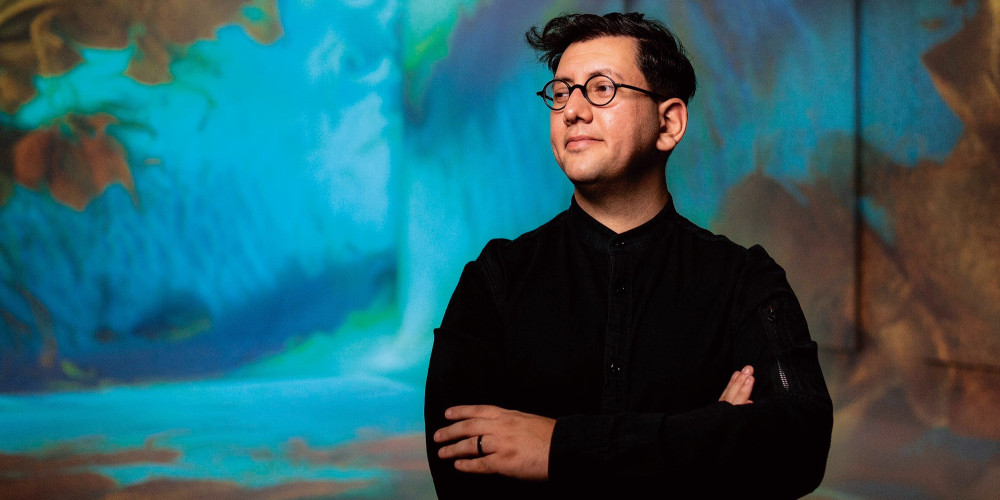
Refik Anadol is a world-renowned media artist and a vanguard in the aesthetics of data and machine intelligence. In the presence of his creations — which dissolve the very boundaries between technology and art — we find ourselves compelled to pause, to marvel, and to reconsider the meaning of the word “connection.” MorningCalm had the privilege of sitting down with Anadol, an artist celebrated for actualizing “human-centric values” through the compelling medium of artificial intelligence (AI).
Data Sculptor
This past February in Dubai, at the presti¬gious TIME100 AI Impact Awards, Turkish- American media artist Refik Anadol was distinguished as one of four prominent figures shaping the future of artificial intelli¬gence. This honor shows international recog¬nition of his pioneering journey over the past decade, using AI as a medium for artistic experimentation and delivering public messages. Anadol transcends the mere use of AI as a creative tool, instead posing a funda¬mental question that redefines the frontiers of AI and art: “If machines can imagine and dream, to what horizons can art then expand?”
At the start of his career, Anadol specialized in photography and video at Istanbul Bilgi University, later earning a Master of Fine Arts degree at UCLA’s Department of Design Media Arts. Subsequently establishing Refik Anadol Studio in Los Angeles, he has continued to develop his significant body of work, while concurrently teaching and conducting research at UCLA. His landmark projects include WDCH Dreams, a projection of the Los Angeles Philharmonic’s archival data onto the facade of the Walt Disney Concert Hall; Living Architecture: Casa Batlló, which reflected real-time climate data onto Gaudí’s iconic building in Barcelona; and Unsupervised, an AI-inspired piece exhibited at New York’s Museum of Modern Art (MoMA).
The true distinction of Anadol’s acclaim lies in his approach to AI not merely as a novel instrument, but as an artistic collaborator, a co-creator. Through data and algorithms, he reconstructs emotions, memories, ecologies and civilizations. He states, “When machines transcend mere information processing to dream alongside us, it heralds the dawn of a new artistic vernacular.” An artist who elicits humanity and emotion from the seemingly cold arrangements of technology — this is what distinguishes Refik Anadol today.
His artistry finds its most radiant expression in public arenas and immersive media landscapes. Whether transforming architec¬tural facades into vast canvases or crafting all-encompassing exhibitions where the audience becomes an integral part of the experience, he explores the democratic and expansive potential of art. He is an artistic rarity, capable of evoking both techno¬logical awe and deep emotional resonance simultaneously.
Anadol now prepares to unveil a space that culminates his years of experimentation and profound inquiry: DATALAND, the world’s first AI art museum, slated to open at The Grand LA in Downtown Los Angeles this year. Anadol defines this space as both a “technical sanctuary” and “the first venue where the aesthetics of the digital age are made manifest.”
He defines the essence of art as a transfor¬mation of perception. Artificial intelligence, in his view, is not a force to replace creativity, but a potent tool for its expansion. Trained on data imbued with cultural, ecological and emotional memory, AI creates new forms of beauty where humanity, nature, machines and memory intersect. Refik Anadol’s art explores how technology can connect with our shared humanity, aesthetically manifesting these very possibilities. This might explain why, today, the world watches him with keen anticipation.


Interview
We are now entering a true AI era with the public and the scope of art has expanded. Thanks to you, the public has started experiencing AI art in a meaningful way. How did you begin this kind of work?
My journey with AI art began with a deep fascination for data and memory. I was drawn to the idea that machines could not only process information but also dream with us — that algorithms could help us visualize the invisible. In 2008, while pursuing my graduate studies in Los Angeles, I started experimenting with architectural projection and real-time data. Over time, this evolved into a practice where AI became a collaborator — not a tool — to create art that transforms data into poetic, immersive experiences. But, it was in 2016, as the first artist in residence at Google AMI, when a significant milestone happened. There, in my deep conversations with Blaise Agüera y Arcas and K Allado-McDowell, we addressed the challenge of demystifying the complex AI tools.

The primary canvases for your work are often large exterior walls or public spaces. How important is the concept of publicness in your work, and what does it mean to you?
Public space is a democratic canvas — it belongs to everyone. My work aims to transform these spaces into open-air archives of collective memory, where anyone, regardless of background, can access and engage with contemporary art. Projects like Living Architecture: Casa Batlló in Barcelona or WDCH Dreams in Los Angeles were conceived to connect cities and their
inhabitants through data-driven storytelling. To me, art should be for anyone, of any age and from any background. Public art projects are the most meaningful ones to me.

Your work has a very technology-centered approach. What efforts do you make to bring humanity into it?
Technology is only the starting point. My true subject is humanity — our collective memories, our shared experiences and our dreams. I work with datasets like urban wind patterns, coral reef images or even the memories of Alzheimer’s patients, and train AI models to reimagine them. I want to create
spaces where viewers feel connected not just to the artwork, but to something larger: the planet, each other or even themselves.
In today’s world, where there is a constant
contemplation about the authenticity of AI, I’m curious to know your thoughts on the authenticity and essence of art.
Authenticity is no longer just about the artist’s hand — it’s about intention, action and transparency. In my view, AI does not replace creativity; it expands it. By training AI with curated datasets that capture cultural, ecological or emotional memory, we
can unlock new modes of expression. The essence of art, for me, lies in its ability to transform perception and that remains true whether it’s created with a brush, a camera or a neural network.

Ultimately, what do you want to communicate through your work? What do you hope people will feel when experiencing your art?
I hope people feel a sense of awe — not just at the scale of the visuals, but at the beauty of the world as seen through the lens of data. I want to spark curiosity and reflection. I want people to feel more attuned to the rhythms of life — both human and nonhuman. My art is an invitation to pause, to wonder and to dream together.
Where to Meet the Art of Refik Anadol

Guggenheim Museum Bilbao
in situ: Refik Anadol
2025. 3. 7 – 10. 19
The Guggenheim Museum Bilbao, nestled in the northern Spanish city of Bilbao, stands as an icon of contemporary architecture designed by Frank Gehry and a celebrated symbol of urban regeneration. in situ: Refik Anadol reinterprets Frank Gehry’s architectural legacy through the lens of artificial intelligence, exploring how machine intelligence visualizes and reconstructs architectural memory and form.
- guggenheim-bilbao.eus
- Korean Air operates direct flights between Incheon and Madrid 4 times a week.
Kunsthaus Zürich
Glacier Dreams
2025. 1. 17 – Mid 2026
Kunsthaus Zürich, Switzerland’s largest art museum, houses an expansive collection spanning from the Middle Ages to contemporary works. It garnered further acclaim with the 2021 opening of its eastern extension, designed by David Chipperfield. Glacier Dreams, drawing upon a global glacier archive and the artist’s own expedition data, conveys the profound impact of climate change on Earth’s ecosystems through a potent and dynamic visual language that resonates deeply.
- kunsthaus.ch
- Korean Air operates direct flights between Incheon and Zürich 3 times a week.


Istanbul Modern
Infinity Room: Bosphorus
Permanent
As Turkey’s inaugural modern art museum, Istanbul Modern focuses on introducing Turkish modern and contemporary art to both domestic and international audiences, significantly contributing to the global understanding of Turkey’s cultural identity. Refik Anadol’s Infinity Room: Bosphorus, in the Istanbul Modern’s permanent collection, utilizes dynamic datasets generated from real-time meteorological data of the Bosphorus, the city’s iconic strait. It reconstructs landscapes of the Bosphorus past and imagined, in a manner that is at once hypnotic and poetic.
- istanbulmodern.org
- Korean Air operates direct flights between Incheon and Istanbul 7 times a week.
Futura Seoul
Echoes of the EARTH: Living Archive
2024. 9. 5 – 2025. 1. 10
FUTURA Seoul, a contemporary art platform nestled in the heart of Bukchon, fluidly bridges the past, present and future. True to its name — derived from the Latin word futura, meaning “future” — the space reimagines the boundaries of artistic expression, offering refined perspectives on the emotional textures of everyday life. Its inaugural exhibition, Echoes of the Earth: Living Archive, the Asian debut solo show of Refik Anadol, invited audiences into a profoundly immersive experience where art, science and technology converge in a dynamic dialogue.
- futuraseoul.org

- Written by Choi Jini
- Photo courtesy of Refik Anadol Studio
- Cooperation Futura Seoul