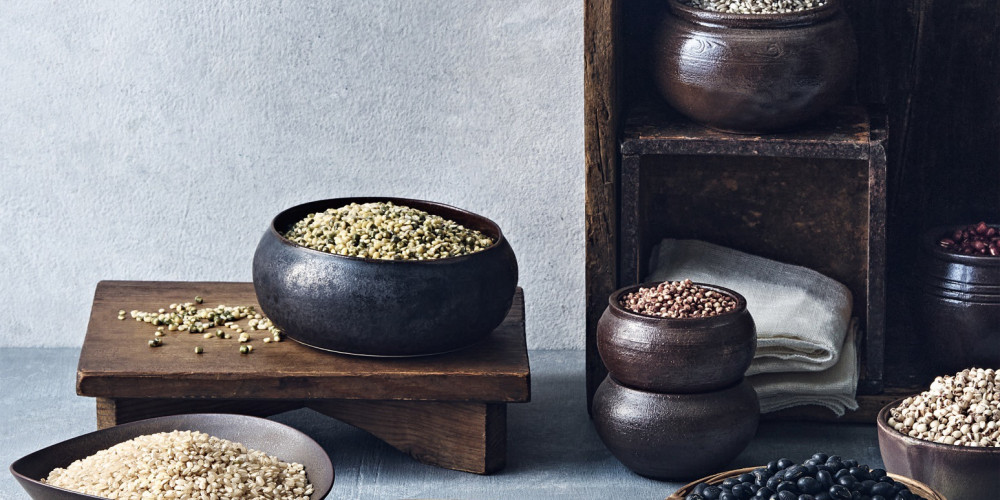
A Bowl of Grains
As summer’s heat intensifies, the Korean table naturally welcomes dishes made from beans and grains. This is not merely seasonal fare, but rather a climate-responsive food culture born from the ingenuity of ancient Koreans.
Food Birthed FromMidsummer Grain Preservation
Long before scholar Kim Chang-eop (1658 – 1722), an envoy of a Joseon Dynasty (1392 – 1910) diplomatic delegation bound for Beijing, set out on his journey in the eleventh lunar month of 1712, his wife was a flurry of activity, preparing sustenance for his arduous adventure. Kim’s own diary from this mission records a cache of dried provisions — abalone, beef, pheasant, mussels, jujubes and ginseng. Tucked within his satchels, one can well imagine, were also portions of steamed rice grains and a nutritious roasted grain powder known as misutgaru.
An evocative Korean name for a finely milled powder, misutgaru is made from grain kernels that are first steamed, then dried, and finally roasted to a gentle nuttiness. When this powder is whisked into a cup of water, it transforms into a remarkably restorative grain porridge, an ideal source of nourishment for those whose appetites have waned. The “misu” in misutgaru finds its roots in a derivative of the Sino-Korean term misik (穈食), signifying simply a “powdered sustenance.” Thus, misutgaru is the essence of powdered grain, and the simple yet appetizing dish it creates is known as misu.
With the dawn of the 20th century, and the newfound accessibility of ice in major cities even at summer’s peak, urban dwellers began to enjoy misutgaru as a cold beverage, stirring the powder into iced water. Since the 1990s, Korean food brands have offered a variety of misutgaru blends, artfully combining ingredients like glutinous rice, barley, Job’s tears (a mildly sweet, earthy Asian grain), brown rice, and an assortment of beans — all meticulously ground, roasted or steamed.
In contemporary Korea, misutgaru is often approached with a certain reverence, akin to seonsik — the pure, unadorned fare of Buddhist monks engaged in deep meditation — a food thought to gently quiet the mind’s chatter.


Wholesome DishThat Tamed Scorching Summers
The 19th century scholar Hong Seok-mo (1781 – 1857), in his chronicles of the era’s seasonal customs, observed that during the sixth lunar month, the people of Seoul would “prepare noodles from wheat flour, embellish them with cucumber and chicken, and partake of them in a baekmajatang (a savory white perilla seed soup).” The term baekmaja refers to perilla seeds, for which the Sino-Korean characters are imja (荏子). Interestingly, during the latter part of the Joseon period, a similar white soup prepared with sesame seeds instead of perilla was also affectionately known as imjasutang (荏子水湯), an elegant noodle creation featuring wheat noodles bathed in a chicken broth subtly enriched with the aroma of roasted sesame seeds. The wheat cultivated on the Korean peninsula is traditionally winter wheat, sown in the autumn and harvested just before the arrival of the summer monsoon. In Hong Seok-mo’s time, winter wheat was not produced in great abundance. Consequently, imjasutang, a refined combination of young chicken and fine wheat noodles, was a summer delicacy reserved for the affluent.
Another summer delicacy, held in equally high regard by the affluent and often mentioned in the same breath as imjasutang, was suranchae. In a testament to its esteemed status, when the late Queen Elizabeth II of the United Kingdom (1926 – 2022) visited Andong’s historic Hahoe Village in April 1999, the dish was chosen to grace the banquet table celebrating the Queen’s 73rd birthday.
The foundation of suranchae’s exquisite flavor lies in its broth, a blend of finely crushed pine nut extract, delicately seasoned with salt, vinegar and sugar. Its elegant adornments include rehydrated rock tripe mushrooms, tender carrots lightly boiled and artfully carved into floral shapes, sweet snow crab leg meat extracted from its shell, crisp water parsley (minari) briefly blanched, and finely sliced red chili peppers.
Yet, the undeniable protagonist of suranchae is the suran itself — a perfectly poached egg, gently slipped from its shell into simmering water and cooked until just softly set. This delicate suran is then carefully lifted and placed atop the artfully arranged ingredients. A final drizzle of pine nut extract completes the presentation, unveiling a dish of stunning chromatic brilliance.


Korean Culinary Traditions Enchantingthe World’s Palate
Beans, a powerhouse of protein, have long been a corner-
stone of Korean summer cuisine, essential for replenishing vital nutrients during the season’s most demanding days.
The 1957 culinary tome, Yijo Gungjeong Yoritongo (A Compre-hensive Study of Joseon Royal Court Cuisine), authored by Han Hui-sun (1889 – 1972), the last kitchen court lady from the Korean Empire (1897-1910), features a treasured recipe for kongguk naengmyeon. The ingredient imparting its characteristic nutty depth is sesame. Soybeans and sesame seeds are traditionally ground together using a millstone, the resulting paste painstakingly strained through a fine sieve, then gently thinned with water and seasoned with salt to create the smooth, rich kongguk (soybean milk broth), which is then chilled. Cooked wheat noodles, refreshed in icy water, are arranged in a bowl, and the cool kongguk is generously ladled over them.
The book notes, “This kongguk naengmyeon is a dish consumed during sambok, the three hottest days of summer.” By the mid-1970s, Koreans commonly referred to kongguk naengmyeon simply as kongguksu. During the heat
of summer, kongguksu became so popular that it was served not only in neighborhood eateries (bunsikjip) but also in Chinese restaurants. A particular restaurant in the southwestern province of Jeollanam-do gained local fame for its version, which featured a mountain of roasted soybean powder and finely shaved ice piled atop the wheat noodles. This harmonious meeting of the nutty flavor of soybean powder and the refreshing chill of shaved ice, coupled with
the additional protein from the soybeans, provided a vital source of summer sustenance for the common people.
The shaved ice gracing the kongguksu was produced by an ice shaver (bingsakgi or Snow Ice Machine). This device was invented in Japan in the late 19th century. The Japanese refer to the shaved ice dessert, made by shaving blocks of ice with such a machine, as kakigori. When kakigori was introduced to Seoul in the 1920s, Koreans called it bingsu. At that time, the Japanese typically topped kakigori with condensed milk, along with sugar or sweetened cooked adzuki beans. In the early 1970s, Koreans adapted the Japanese practice of adding such beans to create the patbingsu we know today.
In the mid-1990s, a Korean fast-food restaurant that opened south of Tiananmen Square in Beijing, China, sold patbingsu under the name hóngdòu bīngshān (red bean ice mountain). This marked the first overseas foray of patbingsu. Since the 2000s, establishments ranging from hotel cafés to fast-food outlets in the United States have showcased new variations of patbingsu as a signature Korean dessert as the summer season approaches. Today, patbingsu proudly holds its place as a beloved K-Food classic.
As our planet warms, many regions now grapple with unforeseen and unseasonable heat waves. In an era that knew neither refrigeration nor the easy abundance of ice, the Korean people ingeniously navigated the fiercest summers with the simple wisdom of powdered grains and carefully steamed cereals.
Even now, with all the modern marvels of refrigerators and air conditioners at our disposal, might not a nourishing bowl, a result of timeless Korean ingenuity, still offer a potent means to vanquish the most unexpected summer swelter?
Joo Youngha is one of Korea’s leading food anthropologists and a professor at the Graduate School of Korean Studies at the Academy of Korean Studies.
-Written by Joo Youngha
-Photography by Park Dabin
-Food styling by Moon Inyoung