
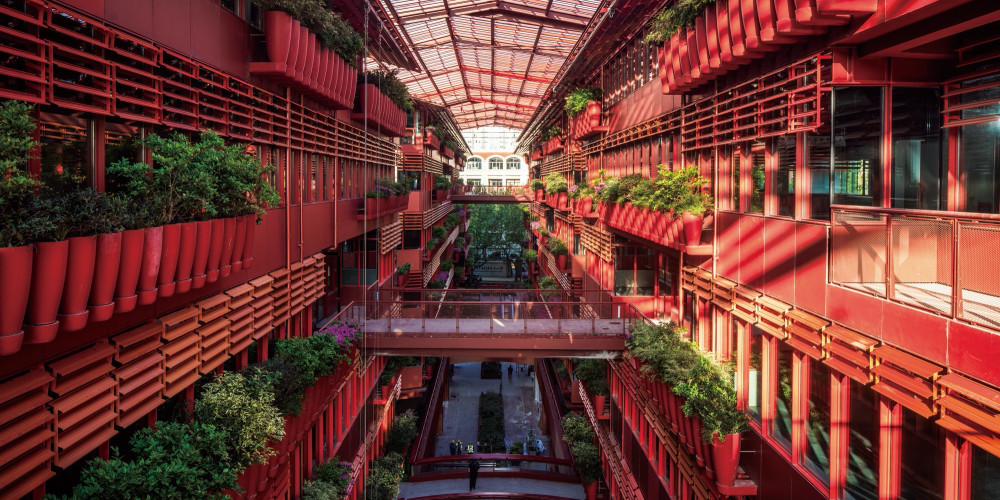
Under the Red Roof, The Roof
The Roof is a unique lifestyle and retail complex integrated into the Henderson CIFI Tiandi building designed by Jean Nouvel offering a modern reinterpretation of the rich historical context of Shanghai’s Xintiandi neighborhood. Embracing both the unique spatial character of traditional lilong alleyways and the collective memory symbolized by the red flowerpots of the past, it presents a new architectural language that connects the city and nature, the past and the future.


Building Context, Not Just an Icon
Jean Nouvel is an architect who has always valued both context and style. But his work goes beyond a simple interpretation of its surroundings; it creates a stage where past and present can collide and converse. He is known for creating iconic buildings, but they surpass mere aesthetics and are always rich with historical context and poetic, philosophical metaphors. What’s truly remarkable is that his creations, while deeply rooted in history, are simultaneously infused with cutting-edge technology and a bold, futuristic vision. His architecture stands at the very pinnacle of engineering, yet it is always in communion with a deep poetic sensibility.
The Roof, a covered passageway that bisects the Henderson CIFI Tiandi building in Shanghai’s former French Concession, is a continuation of this philosophy. To truly understand it, one has to first appreciate the unique history of Shanghai’s foreign concessions. A concession was an area within a city that was governed by a foreign power with its own extraterritorial rights. After the end of the First Opium War in 1842, a British Concession was established in the area around what is now the Bund and Nanjing Road in 1845, followed by a French Concession in the areas of Huaihai Road and Xintiandi. And with each concession, a different urban culture took root.

Unique Mix of Architectural Styles
The concessions were originally intended only for foreign residents, but as more and more Chinese residents began to move into the areas, a new, intermediate form of housing was needed. As the concessions expanded, a new residential style known as shikumen developed, blending the traditional Chinese courtyard house, or siheyuan (a home where four buildings are arranged around a central courtyard), with Western architectural styles. The traditional, gender-segregated hierarchical family structure embodied in the courtyard home was fused with the Western-style terraced townhouse to create a new, medium-density communal living space.
The modern urban cultural hub of Xintiandi has been redeveloped from a neighborhood once dense with these traditional shikumen alleyway homes, known as lilong residences. In his design for The Roof, Jean Nouvel has embraced the historical context of the lilong alleyway neighborhoods, translating their ambiguous boundaries and wonderfully unpredictable pathways into a modern architectural language. He has taken the vibe of these alleyways’ labyrinthine charm, and reimagined it on a contemporary architectural scale, transforming the sensory experience of a complex, unregimented network of streets and alleys into a grand, poetic vision.

Fresh Architectural Twist on Shanghai’s Past
The Roof is a single complex made up of four interconnected wings. The covered central passageway connects to various interior spaces and also links to a subterranean plaza, designed to be able to host small-scale events. A new type of alleyway that intentionally blurs urban boundaries, The Roof invites people to linger and experience the space in a multitude of ways. Through this ambiguous sense of space, Nouvel is proposing a novel approach for architecture and the city to meet. To make this space even more dynamic, Nouvel integrated into the exterior walls and arcade spaces some 2,500 flowerpots that transform the building into a living, breathing entity.
This addition transforms the structure into a garden that changes with the seasons and brings a vibrant, dynamic quality to the urban landscape. More than just aesthetics, this green space also functions as a living organism within the city, helping to reduce fine dust, mitigate the urban heat island effect, and regulate the neighborhood climate. The brilliant red of the flowerpots is a reference to the traditional red bricks of the lilong houses, and it’s a color that symbolizes good fortune and vitality in Chinese culture. It’s a formidable gesture, evoking the history and collective memory of old Shanghai through a single, powerful color. The Roof, which blends both architecture and landscape, is a recreation of the modernized lilong, a symbol of the Shanghai of today and tomorrow.
Places to Explore Around The Roof
Shanghai Former Provisional Government Site of the Republic of Korea
Korea’s provisional government operated in China from 1919 to 1945, and this historic site served as its headquarters in Shanghai. This building, with its preserved offices and living quarters used by activist leaders, tells a powerful story of their efforts to gain international recognition of Korea as an independent country.
- No. 4, Lane 306, Madang Road, Huangpu District, Shanghai
Xintiandi North & South Blocks
A district where old and new Shanghai meet, the North Block keeps the charm of shikumen houses, while South Block offers modern dining and shopping, including the popular lifestyle destination The Roof.
Shanghai Museum
Founded in 1952, the Shanghai Museum is a
leading museum of ancient Chinese art. The main branch at People’s Square hosts special exhibitions in collaboration with major museums worldwide, while the Shanghai Museum East in Pudong has
20 galleries where visitors can explore the vast collections including bronze, calligraphy, painting, ceramics and more.
- shanghaimuseum.net
Huaihai Middle Road
Holding on to the charming atmosphere of the old French Concession, this is one of Shanghai’s most famous shopping streets lined with luxury boutiques and global brands, along with stylish restaurants and bars. In the evening, the street comes to life with neon lights and city views, making it an ideal spot for a romantic dinner or a leisurely stroll.
Yu Garden
Built during the Ming Dynasty, Yu Garden (also known as Yuyuan Garden) is one of Shanghai’s top attractions, a place where ponds, pavilions, rockeries and a historic teahouse come together to showcase the beauty of a classical Chinese garden. As part of the itinerary, head to the adjacent Yuyuan Bazaar to pick up souvenirs and grab local snacks.
- 218 Anren Street, Huangpu District, Shanghai
- Lee Jeonghoon is the principal architect at JOHO Architecture. In 2013, he was the only Korean architect named in Architectural Record’s Design Vanguard program, a list of the 10 architects leading the next generation of building design.
- Written by Lee Jeonghoon
- Photography by 10 Studio
- Korean Air operates direct flights between Incheon and Shanghai 21 times a week.


