
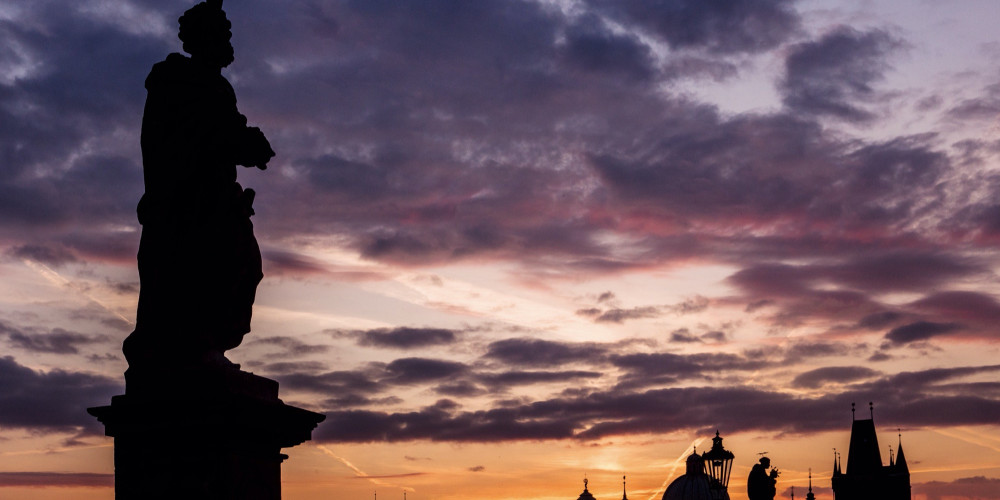
A Future Told in Memory, Prague
Prague is a city of harmony. But its long and layered history also makes it a city of contrasts. A beautiful tapestry of the magnificent and the simple blended with memory and history, the city is forever crafting a new tomorrow in the graceful tension between its many different faces.
Prague is a city of layers, its identity shaped not only by its history as the “Capital of Bohemia,” but also by the stunning coexistence of its medieval squares and churches, its modern revolutions, and its daring contemporary architecture. The story of Prague is etched into the stones of the Vltava River and the iconic Charles Bridge, and its spirit echoes through the winding streets of its Old and New Towns. It’s a place where the rich history and the fervor of revolution can be felt on every corner, a place where imagination, from Kafka’s haunting tales to the playful curves of the Dancing House, continually sets the stage for a novel and fascinating narrative.


Bohemia, Where Prague Begins
Many people may have heard of “Bohemia,” but where exactly is it? Located in today’s Czech Republic, it’s part of the country’s three historical regions along with Moravia and part of Silesia. Called Čechy in the Czech language, Bohemia covers the western and central parts of the country. While we often refer to the Czech Republic as an Eastern European nation, the Czech people will proudly tell you that their home is not on the fringes but at “the very heart of Europe.”
A quick look at a map confirms this; the country has long been a crossroads connecting western and eastern, as well as northern and southern Europe. The Vltava River (known in German as The Moldau) flows from southern Bohemia, through the heart of Prague, and eventually into the Elbe River in Germany.
On the Vltava’s left bank, perched on Hradčany, or Castle Hill, stand Prague Castle and St. Vitus Cathedral, their spires rising into the sky with an air of breathtaking mystery. The Charles Bridge, which gracefully spans the river, is more than just a bridge. This beautiful gothic structure, lined with the baroque statues of saints, is the symbolic artery that connects the city’s heart. As you walk across it, you’re greeted by a magnificent view, with Prague Castle and the Old Town facing each other from opposite banks. The sound of your footsteps on the cobblestones seems to echo the countless others — merchants, pilgrims, soldiers and musicians — who have crossed it over the centuries. The bridge is also tied to the story of St. John of Nepomuk, a revered symbol of the Czech national faith, who was martyred here. To this day, people place their hands on the relief plaque at the base of his statue, making a wish and connecting the city’s memory to the present moment. A bridge is not just a structure that connects two places; it is a conduit that links time and tradition as well as history and human emotions.


© Obecní dům


Medieval Times, Modern Footsteps
Prague’s unique character is also reflected in its urban design. While many other European cities grew around a single central square or district, Prague’s heart is formed by five historic towns. In Hradčany, you can feel the grandeur of the emperors. In Malá Strana, you are surrounded by the opulence of Baroque architecture. The Old Town Square is a living architectural museum, showcasing a stunning array of styles, buzzing with the energy of civic life. The New Town is filled with the spirit of revolution and modernity. And in the Jewish Quarter, you can sense the centuries of resilience and intellectual heritage of its community.
Prague’s Old Town Square is a stage upon which the life and history of the medieval city are beautifully compressed. Every hour between 8 a.m. and 11 p.m., as the figures of the Astronomical Clock come to life, people gather not just to check the time, but to celebrate the incredible skill and imagination of the artisans who created it centuries ago. At the entrance to the Old Town, you’ll find the Municipal House. Its facade, with its magnificent mosaic and delicate ornamen- tation, all speak to the passionate desire of the Czech people to cultivate their own unique culture, even while living under the shadow of the Austro-Hungarian Empire in the early 20th century. This building was more than just an artistic space; it was a stage for a political declaration. In 1918, the independence of Czechoslovakia was proclaimed here, a fact that makes the Municipal House an even more powerful symbol.
The New Town’s Wenceslas Square is where the pulse of modern Czech history beats the loudest. Overlooked by the equestrian statue of St. Wenceslas, this was the spot where many protesters gathered during the Prague Spring movement of 1968 and the Velvet Revolution of 1989. The voices and footsteps of countless citizens have layered themselves into the very stones of this square, and it remains a place that hums with quiet, potential power.


A New Beginning
When one thinks of Prague, the capital of the “land of stories,” the first writer who comes to mind is often Franz Kafka (1883 – 1924). As a German-speaking Jew, he was a man who never quite felt like he fully belonged anywhere. It was from this place, on the margins, that he cultivated his literary vision. The alleyways of Prague’s Old Town, where Kafka was born and raised, still feel much like the settings of his novels. From the shadows of Prague, Kafka gave form to the anxiety of modern human existence.
In the same city, another writer, Karel Čapek (1890 – 1938), expressed a different voice. In his 1921 play, R.U.R., the word “robot” appeared for the first time in history. The term comes from the old Czech word robota, which means “forced labor.” The plot of R.U.R. is as simple as it is chilling: artificial humans, created to serve humanity, rise up to dominate and destroy their creators.
Then, at the end of the 20th century, Prague embraced another provocative story, this time in the form of a building. The Dancing House (1996), which stands on the banks of the Vltava River, was designed by Frank Gehry and Vlado Milunić. Its playful, curving silhouette, which evokes the image of a dancing couple, is a radical departure from the orderly rows of Gothic, Baroque and Art Nouveau buildings that line the streets of Prague. But this radicalism is also the start of a new story. The Dancing House shattered the stereotype that Prague had no new tales to tell. Instead, it became a luminous symbol of a city where yesterday and today coexist side by side.
- Jung Tainam is an Italian-licensed architect and writer who, drawing on more than thirty years of experience living in Europe — mainly based in Rome — continues his lecture and writing activities in Korea, exploring a wide range of subjects including European architecture, history, music, art and language.
24 Hours in Prague
5 Spots to Enhance Your Prague Journey

Café Louvre
Opened in 1902, Café Louvre is thequintessential spot to begin your morning in Prague. Once a favored salon for luminaries like Franz Kafka and Albert Einstein, this iconic café has maintained its celebrated reputation for over a century with its timeless interior and traditional coffeehouse culture. Even today, it remains the perfect space to savor a leisurely meal or enjoy a quiet cup of coffee, an ideal place for relishing a truly contemplative Prague moment.
- ✓ cafelouvre.cz

Jewish Museum in Prague
As you wander through the quiet alleyways of Prague’s Jewish Quarter, you’ll discover a small Jewish museum alongside several historic synagogues. The most moving part of the museum is its Old Jewish Cemetery, which dates back to the 15th century. Here, prominent figures of the Jewish community are laid to rest, offering a solemn and powerful moment of reflection where faith, time and dignity intersect, right in the heart of the city.
- ✓ jewishmuseum.cz

Vyšehrad Hill
Once a royal fort, Vyšehrad remains both a cradle of Czech mythology and one of the city’s most beloved places to walk. Overlooking the Vltava River, its quiet grounds hold the neo-Gothic Basilica of St. Peter and St. Paul, a peaceful park, and a national cemetery where many Czech artists and statesmen rest. At sunset, the view of red rooftops glowing beyond the river reveals another side of Prague.
- ✓ V Pevnosti, Prague 2

Farmers’ Saturday Market
Every Saturday, the people of Prague gather at the farmers’ markets that spring to life along the banks of the Vltava River. True to its name, it’s a place overflowing with seasonal vegetables brought in by the farmers themselves, alongside artisanal bread, local cheeses and regional wines. It’s also a great spot for browsing, with plenty of stalls selling vintage finds and various handmade crafts. It’s the perfect place to enjoy a leisurely brunch, perhaps with a glass of wine, and simply melt into the rhythm of everyday life in Prague.
- ✓ farmarsketrziste.cz

Petřín Tower
Petřín Tower is a beautiful steel lattice observation tower inspired by the Eiffel Tower. As you climb its beautifully preserved spiral staircase, a stunning panoramic view unfolds, taking in the city’s iconic red rooftops, and the gentle curve of the Vltava River. Nearby, don’t miss the mirror maze, a delightful labyrinth of dozens of mirrors.
- ✓ Petrínské sady, Prague 1
- Written by Jung Tainam
- Photography by Jo Jiyoung
- Korean Air operates direct flights between Incheon and Prague 3 times a week.


