The World of Lee Bul
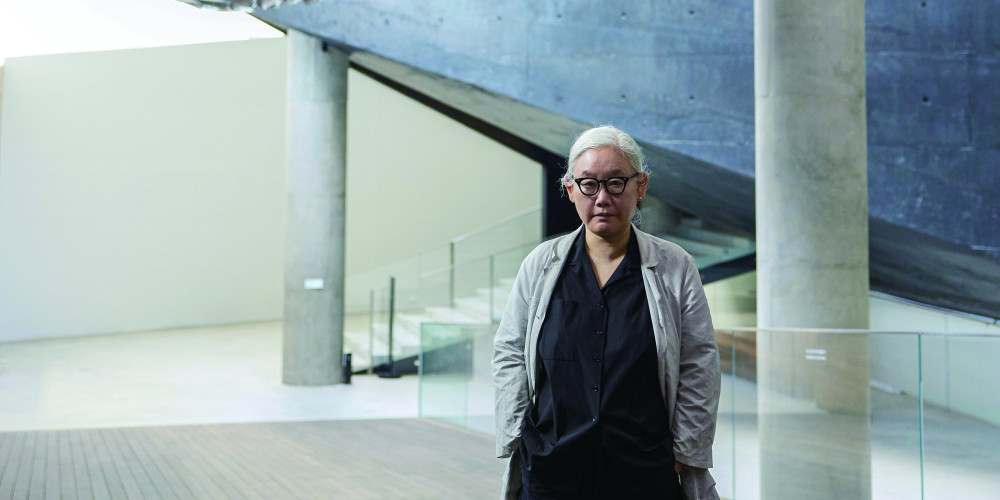
Lee Bul is not just one of Korea’s most important contemporary artists; she is a name that is essential to any conversation about art on the global stage. From her early, provocative performances centered on the body to her later, sweeping explorations of civilization and utopian narratives, she has always been an artist who pushes boundaries, forging a new and powerful language all her own.
A Time to Revisit Lee Bul
This winter, if there’s one name that’s sending ripples through the Korean art world, it is without a doubt Lee Bul. A major survey exhibition of her work is now open in Seoul. For anyone interested in contemporary art and culture, Lee Bul is a name you need to know.
One of the early works that is essential to understanding her art is Majestic Splendor, a piece she installed at New York’s Museum of Modern Art (MoMA) in 1997. The installation consisted of dead fish, elaborately adorned with glittering sequins and beads. As time passed, the fish began to decay, and a powerful stench filled the gallery. The process itself was the artwork. This single, unforgettable gesture conjured up the opposing sensa- tions of beauty and disgust, ornamentation and collapse, laying bare the societal contradictions that often hide behind a glamorous surface. The ensuing controversy (the piece was eventually removed due to the smell) became a legendary moment that announced the arrival of a bold young Korean artist on the international stage.
From that explosive moment, she has continued to forge her own path, expanding her artistic reach in ever-bolder strides. She moved from her radical early performances to a deep exploration of utopian modernism, the avant- garde traditions of art and architecture, and humanity’s long-held desire for progress. In her work, utopia is a future that is brilliant but flawed, a space made all the more urgent and desirable precisely because it can never be fully reached. Her materials evolved as well, incorpo- rating mirrors, metal and LED lights, and her work took on an increasingly architectural, environmental scale. The viewer was no longer just looking at a piece of art but was invited to step inside it — to come face to face with the yearning for utopia and its shattered fragments.
The current exhibition in Seoul features some 150 works, including sculptures, installations, large-scale structures, drawings and models. While her pre-1998 work often foregrounded political messages and the language of the body, her later pieces have evolved to contemplate the fate of civilization and humanity as a whole. It is a moment for a much-needed re-evaluation of her work, moving past the limited, early descriptions of her as a “female warrior” to see her in the full context of contemporary art. What makes this exhibition even more special is that it is merely the first stop on a major international tour. With its debut in Korea, it makes a powerful statement: it is time to read Lee Bul anew.

© Lee Bul. Photo: Jeon Byung-cheol. Courtesy of the artist and Leeum Museum of Art

© Lee Bul. Photo: Jeon Byung-cheol. Courtesy of the artist and MMCA, Korea
Keywords: Lee Bul
Lee Bul: From 1998 to Now
The year 1998 in the exhibition’s title serves as a reference point, signaling the shift in Lee Bul’s artistic journey and drawing focus to the work she has done since. But because her themes and interests have been a continuous thread from the very beginning, the show feels less like a sharp break and more like a natural evolution. Just as a person grows and their interests expand outwards from the self to their surroundings and the contemporary world at large, her art has flowed from performance into new and evermore expansive forms.

© Lee Bul. Photo: Jeon Byung-cheol. Courtesy of the artist and Leeum Museum of Art
An Identity Beyond Borders
In the early 1990s, Lee Bul began to get international attention with a series of powerful performances and body-centric works, and she was quickly labeled a feminist artist. While her work did indeed intersect with feminist art in that she put the female body front and center and explored themes of social oppression, that label was never quite sufficient. She wasn’t interested in the body only in terms of gender; she expanded the question to connect it to broader themes of history, civilization, technology and politics. “I’ve never tried to define my work in any one framework,” she says. “It wasn’t a conscious choice. I simply followed my interests and other people were the ones who attached the labels.” Her work can’t be reduced to a single slogan. Instead, it is a record of a restless and experimental mind, a body of thought that is constantly changing and expanding beyond any single border.

© Lee Bul. Photo: Jeon Byung-cheol. Courtesy of the artist and Leeum Museum of Art
Childhood Memory: The Wellspring of Creation
For Lee Bul, a bunker is not just a piece of military architecture. As a child, the bunkers she played in were not symbols of war but an everyday playground, a familiar yet strange stage for childhood games. This unique space would later be resummoned as a source of her artistic exploration. Her memories of her early teens, spent in a satellite city outside Seoul, were also decisive. The neighborhood was a jumble of farmland, a military base and housing for military families — a perfect snapshot of the compressed, rapid modernization of 1970s Korea. She witnessed firsthand the clash between the agricultural and the industrial, as small factories sprang up in the middle of rice paddies and as roads and cement remade a rural town into a city. “Looking back, these interests were not something that came to me as an adult,” she reflects. “They were connected to the memories of the things I dreamed of endlessly, and grew tired of, as a child.” Her childhood memories became a symbol of modern architecture and shifts in civilization, a foundational source for her artistic perspective where memory, history and material all converge.

© Lee Bul. Photo: Patrick Gries. Courtesy of the artist and Fondation Cartier pour l’art contemporain

Lee Bul’s massive installations embody the paradox of the modern age — a world of both brilliant vision and wreckage.
Polyphony of Art and the Bodily Experience of the Audience
For Lee Bul, an exhibition always begins with a reading of the “language of the place.” Rather than trying to suppress its character, she chooses to bring out its inherent nature. This was her approach for the current exhibition at Seoul’s Leeum Museum of Art. The gallery has a unique structure of both compression and expansion, and she took this as a symbolic starting point, arranging the artworks as if directing a film. She chose to begin the exhibition in a dark, metal-clad space to evoke a highly dramatic vibe. Akin to a scene from the film 2001: A Space Odyssey, she created an experience that makes the viewer feel as though they have stepped into an ambiguous, timeless space.
The artworks are also not arranged chronologically. For Lee, the past is not something that is over and gone; it is something that is always returning to the present. In her work, the past, the present and the future that was once dreamed of, all overlap and repeat. Within this rich and layered space, each visitor is invited to create their own meaning, to experience the artwork with their entire body.

© Lee Bul. Photo: Osamu WATANABE. Courtesy of Mori Art Museum
Mon Grand Récit: Where Dreams and Ruins Coexist
In the late 1990s, Lee Bul’s focus broadened from the specific theme of the body to the more expansive areas of architecture, the city and landscapes. Her iconic series from this period, like Cyborg, Anagram and the Karaoke installation, explored the relationship between the human and the machine, the body and technology, and cemented her critical voice on the international stage. These pieces started from a single question: In our post-human condition, how is the body being redefined and represented?
Soon, her interest expanded to humanity’s long-held yearning for “perfection” and the cracks that inevitably appear in that pursuit. This line of inquiry led to one of her most famous series from the 2000s, Mon grand récit (My grand narrative). Shimmering metal structures and concrete walls appear as both symbols of progress and as the ruins of a collapsed ideal. Here, rather than an idealized, perfect future, utopia is an endless cycle of yearning and failure.
Experiments Traversing Flat Plane and Sculpture

© Lee Bul. Image © The Metropolitan Museum of Art. Photo: Eugenia Burnett Tinsley
Her Perdu series, a major focus of this exhibition, is an ongoing body of over 100 flat-plane works. These are not simply paintings, but experiments that apply a sculptural process to a flat surface. She builds up layers of acrylic paint, mother-of- pearl and stone powder, then sands them down to reveal an image. The moment an unexpected form is unearthed feels almost like an archaeological excavation.

© Lee Bul. Photo: Jeon Byung-cheol. Courtesy of the artist
Beyond “Koreanness”
Western artistic movements, the memory of Korea’s modern history, and contemporary social events are all interwoven in Lee Bul’s work. Yet, she refuses to explain it in a simple binary of Korean or not Korean. “My interests,” she says, “are the process of my own coming of age, the things I’ve learned, the place where I live, and the phenomena I see and experience. These elements naturally seep into my work in various ways.” For her, the important thing is not to define a particular identity, but to weave the experiences of her life, her learning, and her engagement with the here and now into her art. This is why her work transcends national and regional borders and functions as an essential, universal point of reference in the landscape of contemporary art.
Where to Experience the Art of Lee Bul

Leeum Museum of Art
Lee Bul: From 1998 to Now
September 4, 2025 – January 4, 2026
Since its opening in 2004, the Leeum Museum of Art has been a pivotal space for showcasing major trends in both Korean and international contemporary art, presenting large-scale exhibitions of world-renowned artists. The museum, with its three distinct pavilions designed by the architects Mario Botta, Jean Nouvel and Rem Koolhaas, is considered an architectural masterpiece. The current exhibition, Lee Bul: From 1998 to Now, is the artist’s first large-scale survey exhibition in Korea, taking a comprehensive look at her journey over almost three decades, from the late 1990s to her most recent works. It features some 150 pieces, from her iconic earlier series such as Karaoke, Cyborg and Anagram to her latest installations and drawings.
- leeumhoam.org/leeum
M+
Lee Bul: From 1998 to Now
March 2026 – TBD
Opened in 2021 in Hong Kong’s West Kowloon Cultural District, M+ is Asia’s first and largest global museum of contemporary visual culture. Its vast collection, which includes not only contemporary art but also design, architecture, film and moving images, offers a comprehensive look at the modern and contemporary art of Asia. The building, designed by the world-renowned architectural firm Herzog & de Meuron in partnership with TFP Farrells and Arup, takes the form of a stunning inverted T-shape. Following its run at the Leeum Museum, the Lee Bul exhibition will travel to M+.
- mplus.org.hk/en
- Korean Air operates direct flights between Incheon and Hong Kong 21 times a week.

- Written by Choi Jini
- Photography by Jeon Byungcheol / Leeum Museum of Art / Image Courtesy of the artist