The Person Walking Toward the Moon
MorningCalm presents Omnibus Story, a series of reflections drawn from the landscapes of everyday life, explored from diverse perspectives. Our hope is that these narratives linger as seeds of inspiration, blossoming throughout your journey when you least expect them.
- Kim Yeonsu is a leading voice in contemporary Korean literature exploring time and memory, love and relationships in delicate, lyrical prose. His books include Whoever You Are, No Matter How Lonely, If the Waves Belong to the Sea and A Future as Ordinary as This. He has also published essays on travel and daily life. His latest collection, Snow Falling on Samilpo, examines art, life and the ways we perceive the world.
1
In 2009, I visited Ungcheon Waeseong in Changwon, South Gyeongsang-do Province. The term waeseong refers to Japanese-style castles built by the soldiers who invaded Joseon (1392 – 1910) during the Imjin War (1592 – 1598). Only then did I learn that many such ruins lay along Korea’s southern coast. To us, they were a dark legacy of the past. Little known and poorly maintained, they had fallen into ruin. In ruins, you have to imagine everything. Many buildings likely stood there, including a castle keep, but now there were only loose stones underfoot. All traces of that long-ago war had vanished. No one remained who remembered what had happened there, who had been there, when they had wept or when they had laughed. Only a small wooden marker standing to one side of Ungcheon Waeseong fortress remembered those days. Its inscription said that Korea’s first Catholic Mass had been celebrated there.
2
Let us follow the tale of the wooden marker. It was the winter of 1593, and Christmas was approaching on the Korean Peninsula. Among the Japanese soldiers who had invaded Joseon, those led by Konishi Yukinaga were Catholics, baptized in the footsteps of their daimyo (feudal lord), whose baptismal name was Augustine. Since invading Joseon a year earlier, they had not attended Mass. Konishi therefore asked the Jesuits in Japan to send a priest. The Jesuits sent Spanish priest Father Gregorio de Céspedes to Joseon. Toyotomi Hideyoshi, Japan’s de facto ruler at the time, did not permit Europeans to enter the Korean Peninsula. The priest had to slip into Ungcheon Fortress, where Konishi’s troops were stationed, and remain hidden in the keep. Only after dark did he descend to the soldiers’ quarters below the castle to hear their confessions. The single inscription on that small wooden marker divulged this story.
There was controversy over whether it was right to honor a military chaplain who had come with an invading army. Even so, I wanted to know what transpired next. When Toyotomi Hideyoshi discovered that Céspedes was on the peninsula, the priest had to return to Japan after a little over a year. On his way back, he stopped on the island of Tsushima and met Konishi’s daughter Maria. The wife of the island’s lord, she was a devout believer who would hold to her faith even after her family fell from power and she was driven from Tsushima. It is said that her faith led Maria to care for Korean orphans brought there as captives. That was how, when Céspedes visited, she was able to introduce him to two boys, telling him that they were bright Korean children. A letter from a Jesuit priest states that the boys’ father had been a loyal servant of the Joseon royal court.I could almost picture the scene: Maria meeting Céspedes, calling for the two boys, and the boys walking shyly toward them. To me, the boys were brothers. I already knew who they were.
3
I decided to write the boys’ story in 2002, the year Korea and Japan hosted the World Cup. That spring, I left the magazine where I worked. When people asked why I was leaving, I said, “I want to watch as much of the World Cup as I can.” No one believed me. My real reason, which I told no one, lay in fiction. There was a novel I had to write. Around that time, I was working for a magazine devoted to publishing. It was run by a public-interest foundation established to support publishers, and twice a week every book published in Korea was delivered to the editorial office. After selecting the books to feature in the next issue, the editor-in-chief would stack the rest on the floor. There were books of every kind. Whenever I needed a break while writing an article, I would leaf through the books on the floor, one by one.
Then one day, I noticed several volumes of a series of books written by foreign visitors who had come to the peninsula during the Korean Empire era (1897 – 1910). Then I came upon this sentence. “Around Christmas in 1593, the Spanish priest Gregorio de Céspedes arrived in Ungcheon as chaplain to Konishi’s troops and came to the aid of orphans.” “Orphans,” I murmured. “Orphans. The orphans of the Imjin War.” I repeated the words as though reciting a mantra. Then, as in a dream, the children became so vivid I could almost reach out and touch them. Orphans. The orphans of the Imjin War. The more I repeated it, the clearer their story became within me, like an old memory returning.
I could see the story clearly in my mind’s eye, but I had no idea how to write it. I was like a child looking at a photograph of Everest’s summit without the faintest idea how to climb there. Over the long years that followed, I slowly came to understand that this is what people call a dream: something they can see clearly in their mind’s eye, without knowing any way to reach it.
4
The first place I visited was the Iberian Peninsula in Europe, where Céspedes’s journey had begun. I started my travels in Granada, Spain. Following the course of his life, I traveled through Madrid, near where his father had served as a royal court magistrate; and Salamanca, where he had joined the Jesuits and dreamed of spreading the faith in the East, before heading to Lisbon, Portugal. The cross-border bus left Salamanca in the morning and did not arrive in Lisbon until after sunset.
I wandered the city in search of traces of Céspedes. One place I visited was the Igreja de São Roque. The great earthquake of 1755 had destroyed almost all of the Lisbon that existed until then, but this Catholic church had miraculously survived. In the late 16th century, young Jesuit priests arriving in Lisbon underwent rigorous training for their missions at the religious monastery attached to the newly built cathedral. The relics and reliquaries of earlier missionaries, including those of St. Francis Xavier, which are still kept in the church, reveal that they learned to obey without reservation and without fear of death, and acquired the knowledge they would need to survive the harsh conditions of their mission fields. This included the skills to endure a long sea voyage. Their first test would be the journey across the equator and around the Cape of Good Hope, then through Goa, Malacca, Macao and finally to Nagasaki.
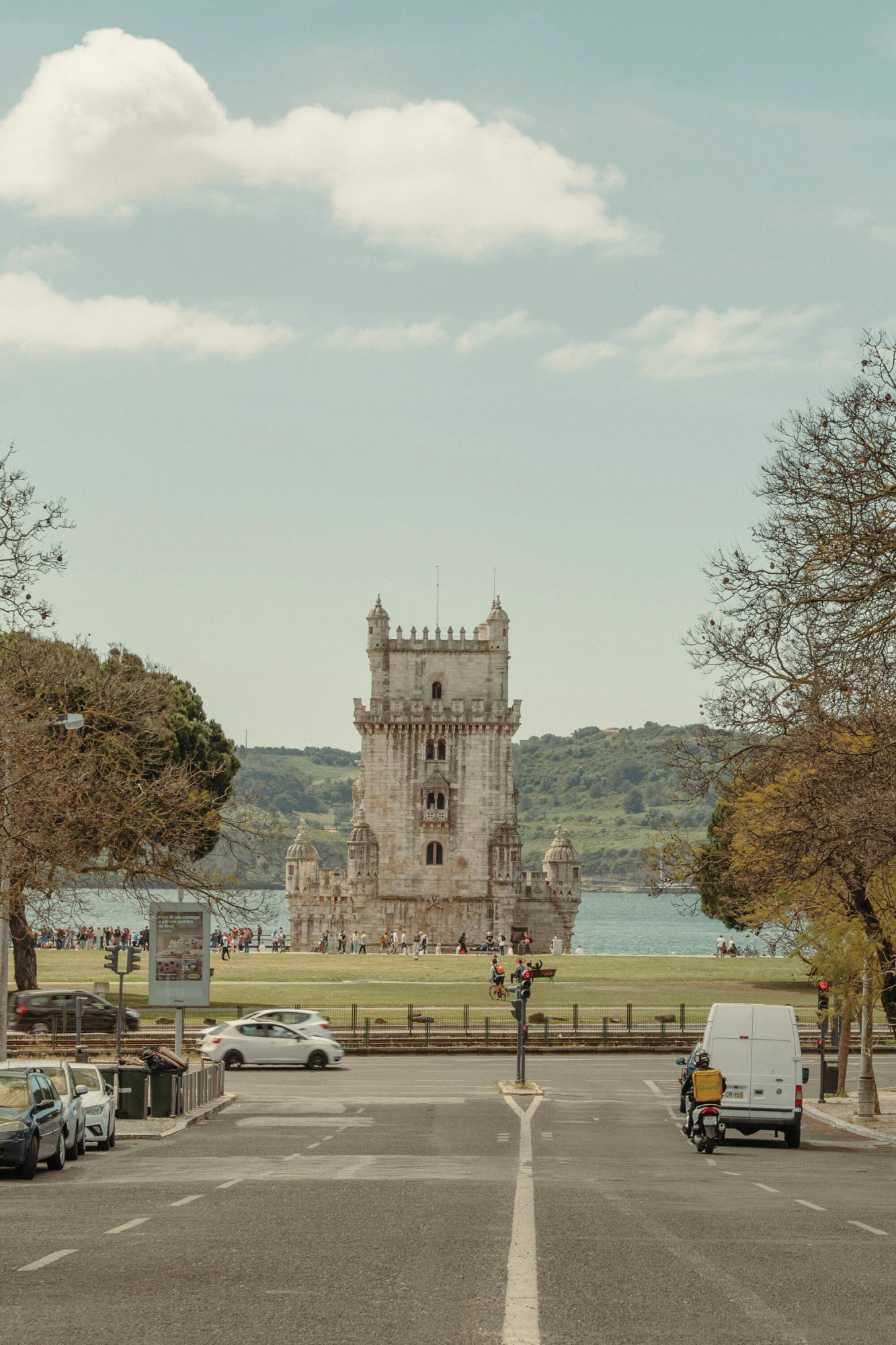
In those days, sailing from Lisbon to Nagasaki took at least two full years. No one knew exactly how long the return journey would take. The young Jesuit priests training at São Roque, Céspedes among them, were around 20 years old. They must have known that they might never return to Lisbon alive. In that sense, they were truly like astronauts boarding a spacecraft that could never come home. Without the belief that their journey would open a new page in human history, they could never have stepped aboard. Belém, in western Lisbon, was where the Jesuit priests, their training complete, finally boarded ships bound for the East. The Atlantic lies just a little way downstream from the waterway, and the view at sunset is beautiful. As evening approaches, tourists pose for photographs against the fading light. One monument invariably appears in those pictures: the Monument to the Discoveries.
It was built to honor explorers on the 500th anniversary of the death of Portugal’s Prince Henry the Navigator, who laid the groundwork for a new sea route around the southern tip of Africa. It is therefore more than just a monument to successful explorers. For Europeans whose passage to the East was blocked by the Islamic powers of the Middle East, the sea route to India offered a new way through. Those who failed did more to open that route than those who succeeded. Prince Henry himself stands for those explorers who failed. Though he sent countless ships south along Africa’s coast, he died without discovering the Cape of Good Hope. That dream was fulfilled by the next generation. Had his dream, then, gone unfulfilled, or had it come true? There are dreams that come true in a world without the dreamer. The Monument to the Discoveries honors those who dream such dreams.

5
I sat on a bench in Belém until the sun had set and the light around me began to fade. When I had looked out to sea from Ungcheon Waeseong fortress and imagined the Lisbon that Céspedes had left behind, it had seemed the farthest place I could possibly go: the end of the world. Now, realizing I was in that very place, I felt the satis faction of having come all the way to the end, and with it the homesickness of a traveler. Céspedes had gone to the ends of the world to spread the truth. But what on earth had brought me all this way? Then the dream appeared before me, like a peak slowly emerging between scattered clouds. My “Cape of Good Hope” was a novel. The story of two brothers born in Korea long ago who, after losing their parents, were caught up in a terrible war and carried against their will as far as Nagasaki, which might as well have been the end of the world.
Through the story’s end, the brothers never give up on a certain dream, a dream that can only be called impossible. They dream of crossing the sea again and returning to their home in Seoul. Even at the end of the world, they keep their eyes on that dream. And just like the two brothers, I looked toward mine. I sat on the bench in Belém until it was completely dark. Then I heard tourists laughing. Their voices sounded happy, as you would expect of people on vacation. Perhaps, at the end of a tiring day, they were looking forward to a good dinner and getting tipsy. But remembering the hardships I had endured to reach the place I now found myself, I suddenly felt the pangs of loneliness. A cool breeze blew off the river, distant lights trembled on the opposite bank, and tears came to my eyes. They came without warning, but I let them fall. It was dark by then, and none of the tourists passing by could tell that I was crying. I was thinking how lonely it was to have held on for more than 10 years to a dream no one else recognized.
6
At the very moment I look at the moon, everyone is looking at the very same moon. The moon is mine alone, and everyone’s at once. Some dreams are like that moon. Prince Henry’s Cape of Good Hope was such a moon. The two brothers I wanted to write about were once looking at this moon, too. The boys in my own novel are modeled on the two boys Maria had introduced to Céspedes. Thankfully, we do know a little about what became of the older boy.
Examined together, various records tell us that his surname was Kwon and his baptismal name was Vincent. Known to have been born in Seoul around 1580, he was about 12 or 13 years old when the Japanese took him during the Imjin War. From Tsushima, he followed Céspedes to mainland Japan, where he graduated from a Jesuit seminary, was baptized and became a Jesuit. Beginning in 1612, the Jesuits sent him on a mission to spread the faith in Joseon, and he crossed over to China.
It was a time of rapid change in Northeast Asia in the wake of the Imjin War. As the Ming dynasty moved toward collapse, Nurhaci was emerging as a new leader in Manchuria. Vincent was swept up in the turmoil of the age like a small boat in a storm. His dream of returning to Joseon, too, broke like the mast of a shipwreck. With circumstances against him, he returned to Japan in 1620. Around that time, the Tokugawa shogunate had begun expelling Jesuit priests and banning Christianity, ushering in a period of brutal persecution. Vincent was driven into ever more desperate circumstances.
7
I finally went to Nagasaki in 2015. It makes me dizzy to think that this was already more than 10 years ago. The reason I went and stayed for half a year was, once again, to write my novel about the two boys. Since then, I have grown 10 years older and still have not finished it. More than 25 years have passed since I first read about them. Will I ever realize that dream? During my stay in Nagasaki, the place I visited most often was Nishizaka Hill. During the period of Catholic persecution, believers who refused to renounce their faith were crucified here. Perhaps the authorities wanted to make an example of Nagasaki because it had once been a port under Jesuit control. Today, the site is a park with a monument to the 26 martyrs — named for the number of the first martyrs of Japan — and a memorial church.
It was at this site that Vincent was executed, after returning to Japan without fulfilling his dream of residing again in Joseon. He had continued to preach while hiding on the Shimabara Peninsula, until he was captured in 1625 and martyred the following year on Nishizaka Hill. Whenever I climbed Nishizaka Hill, I thought of someone walking toward the moon. We may not be able to walk all the way to the moon, but we can walk as if we could. In the same way, we may not be able to fulfill a dream, but we can live as though we might.
Burned at the stake at Nishizaka, Vincent would never fulfill his dream of coming home to Joseon. Yet while he was alive, he lived as though he would. What lay ahead had no bearing on his present. This is what Nishizaka Hill teaches us. We can choose only what we do in the present. The past and the future are outside our control. Here and now, we can choose whether to look at the moon. Vincent spent his whole life looking at that moon. A life spent looking at the moon is meaningful enough in itself. Everyone must have a moon of their own. Whether we ever reach our proverbial moon is not entirely up to us. Here and now, we can make one of two choices: to look at that moon or to look away. If we can see it, we can walk toward it as though it can be reached. I still have not finished that novel, but I penned this essay as someone who might. And if I am to be totally honest, I have lived with that dream ever since I read about the two boys, all those years ago.
- Written by Kim Yeonsu