Humble Deference, Gyeomyang
Flowing through the very bedrock of the Korean psyche is the virtue of gyeomyang(謙讓). More than just politeness or a moral code, this concept of humble deference describes a way of being — one that prioritizes others and steps back without self-aggrandizement. This virtue, which echoes the harmony of the natural world and the wisdom of the classical scholar, has instilled in Korean culture a deep appreciation for beauty that is restrained, unadorned, and gracefully understated.
- Gradation K is a column that explores the beauty and style woven into Korea’s unique aesthetic, from its traditional roots to its modern expressions. Our fourth theme delves into a sensibility that lies deep within the Korean character: gyeomyang, or humble deference. Gyeomyang(謙讓) is the attitude of stepping back quietly, without showcasing one’s own talents, to put others first.

The Art of Stepping Back: An Unassuming Mastery


Virtue of the Humble Scholar
In the age of social media, we live a life of constant self-validation, where every moment is curated and presented for a
chorus of “likes.” We broadcast our thoughts and possessions, endlessly seeking affirmation of our own specialness from a faceless audience. Long ago, however, Koreans lived by a different code. They walked a path of quiet integrity, guided by a principle known as gyeomyang, the spirit of the true scholar.
Instead of seeking the world’s attention, they steadfastly followed the path they believed was right. They learned the art of self-effacement, always showing consideration for other people, and treating everyone with a balanced, respectful demeanor rooted in the Confucian ideal of ye (禮), or propriety. A scholar might have immeasurable wisdom and innumerable skills, but to flaunt them was seen as unrefined. It was this quiet virtue, this elegant restraint, that allowed Korean culture to blossom in its own beautiful way.
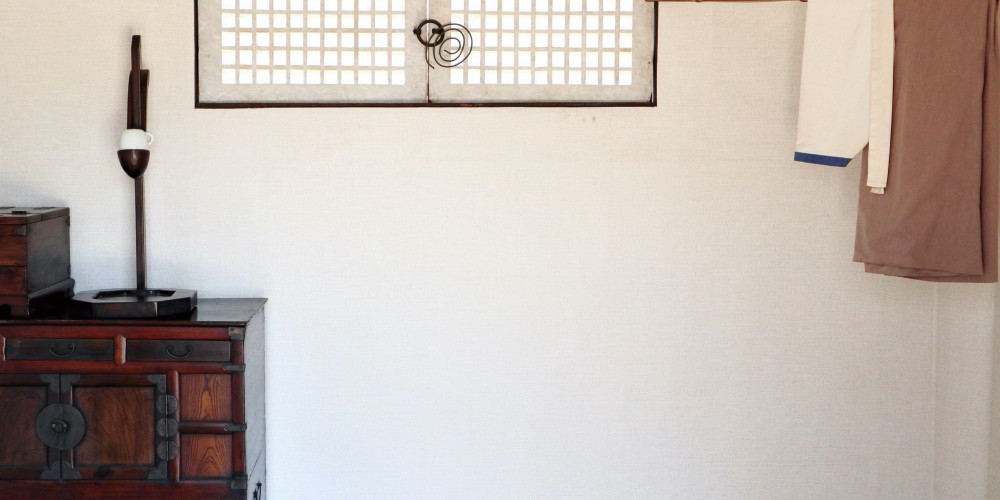
With Confucian culture taking root during the Joseon Dynasty (1392 – 1910), the sarangbang, a room separate from the inner quarters (anbang) of the house, became a male domain. It was a space for scholarly pursuits and hobbies, but also a place for welcoming guests, reflecting the family’s dignity and standing. Here, every morning began with a book opened upon a low writing desk. Food for guests was served with ceremonial care on a small portable table called a soban. On quiet nights, beneath the gentle moonlight, one might hear the murmur of recited poetry or the resonant strains of the geomungo (a traditional stringed instrument). It was a place for intimate conversation between like-minded friends, a space where the noble ideals and utopian vision of the scholar were nurtured.
In the classic text, the Tao Te Ching, the sage Lao Tzu offered this wisdom:
Better to stop short than fill to the brim.
Oversharpen the blade, and the edge will soon blunt. Amass a store of gold and jade, and no one can protect it.
Claim wealth and titles, and disaster will follow. Retire when the work is done.
This is the way of heaven.
It was this very philosophy that guided the lives of the Joseon scholars. They viewed the ostentatious display of wealth as vulgar, and instead found true nobility in a life of simplicity and moderation.


The furniture of the sarangbang speaks to this philosophy. Every piece was crafted with meticulous care, yet designed to be neither excessive nor lacking, always showing a warm consider- ation for the user’s needs. A vivid description of these furnishings can be found in the Sallimgyeongje (Farm Management), a Joseon-era compendium compiled by the scholar Hong Man-seon (1643 – 1715). He lists a wide variety of objects, from the geomungo and tungso (vertical flute) to a writing desk and floor table, headrest and pillow box, inkstone case, brush holder, bookshelf and scroll chest, fan and medicine tube, compass and divination board, all painting a picture of the sarangbang as a remarkably versatile, multi-purpose space. In a way, it was the Western bedroom, living room and study all rolled into one. The seoan, or writing desk, though small — only about 60cm wide and 30cm high — served as the room’s anchor. When receiving guests, its placement helped to maintain a comfortable, respectful distance between host and visitor. The elegant sabangtakja, a multi-tiered open bookshelf, created a sense of graceful emptiness in the room. Its joints were not held by nails but by intricate, interlocking woodwork, and its metal fittings were simple and understated rather than ornate, providing a quiet stage for displaying cherished items like ceramics, brush holders and ink droppers. The yeonsang, a special table for holding the munbangsau (Four Treasures of the Scholar) — namely the brush, ink, paper and ink stone, was crafted in a variety of forms to suit the owner’s taste. The bookcase, a key piece, was above all practical, built with a sturdy frame of zelkova wood to support the weight of heavy books, and paneled with paulownia wood, which naturally repels insects.
Though the sarangbang was often a small room, every object had its place and its purpose, creating a sense of organic harmony. It exuded an unadorned, elegant charm, free of any unnecessary flourish. This refined lifestyle, a beautiful blend of love for the natural world, appreciation for art and poetry, and a quiet sense of personal dignity, still feels like a wonderfully romantic ideal today, reaching across time and space to speak to us today.
寂莫荒田側
繁花壓柔枝
香輕梅雨歇
影帶麥風
車馬誰見賞
蜂蝶徒相窺
自慙生地賤
堪恨人棄遺
On a silent, desolate, hillside field,
Bountiful flowers weigh down a tender branch.
The scent of plum blossoms, now that the rain has ceased, drifts on the air,
Their shadows sway in the barley-scented wind.
Who, in their passing carriage, will pause to admire them? Only the bees and butterflies, in their fleeting dance, come to gaze.
Ashamed of its humble birthplace,
It endures being ignored with quiet grace.
- Written by Chang Inkee
- Chang Inkee is a chief curator at the Onyang Folk Museum. By reviving the wisdom embedded in Korean traditions, she strives to introduce Korean culture to audiences both at home and abroad through exhibitions, educational programs and publications centered on Korean craft and design.
How Korea’s Monochrome Painting Speaks Volumes by Saying Less
Modern art seems to be in a constant state of escalating self-display, forever chasing after ever more dramatic visual forms. But the heart of Eastern aesthetics has always drawn its life from a deep reverence for what isn’t said, from a humble dignity that proves its existence not by showing off but by holding back. This sensibility isn’t flashy. It approaches you like a subtle, lingering fragrance — something you can’t quite put your finger on but can’t forget. It communicates in a language older than words, through a quiet tremor of the senses.
This quality of humility isn’t just about downplaying oneself; it’s an active, ethical stance of making room for others. It’s a poetic ability to read the quiet spaces between people, between all living things, and it springs from a desire for harmony within the community and the cosmos. This unique aesthetic of humility can be traced back to an ancient poem from the Book of Odes, a classic collection of Chinese poetry. In the poem, titled Shuoren (“Distinguished Person”), there is a line that describes an esteemed lady wearing a simple hemp robe over her magnificent silk finery. This beautiful metaphor is about more than just clothing. It gets to the very essence of Eastern aesthetics: the idea of refining beauty by holding back emotion and reining in the desire to show off. Centuries later, Zisi, the grandson of Confucius, quoted this very line in chapter 33 of his classic text, The Doctrine of the Mean, adding, “It is simple, yet elegant; gentle, yet orderly.” He also wrote, “Thus the way of the superior man is hidden but becomes more prominent every day, whereas the way of the inferior man is conspicuous but gradually disappears.” This quiet, understated quality is the beauty of humility. It is the very inner grace that true modesty possesses.
The hero of the original poem was Zhuang Jiang, a noblewoman from the 7th century BC who lived approximately a century before Confucius (551BC – 479BC) during China’s Spring and Autumn Period, and this praise was a tribute to her character as much as her appearance. She wore her simple robe not to hide her beauty, but out of a thoughtful consideration for the common people, so that her own magnificence would not make them feel small but still be in accordance with the prevailing wedding protocol of the era.

(Right) Choi Myoung Young, The Conditional Planes 1831, acrylic on canvas, 1622×2273mm, 2018
Image courtesy of the artist
There’s a line from Zisi’s The Doctrine of the Mean that I have always admired: “Simple, yet elegant; gentle, yet orderly.” For me, it perfectly describes the quiet virtue found in Dansaekhwa. And I can think of no one who embodies this spirit of humility more completely today than the painter Choi Myungyoung, one of the first generation of Dansaekhwa artists. In his work, the artist consistently chooses to conceal rather than to express, to be silent rather than to represent. Choi’s lines don’t describe any particular object. Instead, they are a record of a state of mind, an accumulation of sensation, a natural reflection of an ethical way of being. He relentlessly refuses the temptation of flashiness or easy representation. Instead, he waits patiently for the result that comes only from time, from the endless, repetitive process of checking and re-checking his own inner cosmos.
This emphasis on simplicity is by no means confined to East Asian poetry and painting. The nameless potters of the Joseon Dynasty left behind no signature, yet they managed to capture the boundless universe in the simple, gentle curves of a single moon jar. And what of the folk paintings and genre scenes of the era? They are disarmingly simple on the surface, but this very simplicity contains a hidden aesthetic, an art of concealment that opens onto an endless depth.
This spirit of humility shapes not just aesthetics but the Eastern worldview itself. An ancient text from the Book of Documents puts it this way: “Arrogance invites loss, while humility brings gain.” This isn’t just practical advice for how to get along in society; it is a reflection of the way the universe itself works. The heavens are still and quiet above, and the earth is low and humble below. It is this very humility that allows them to embrace all of creation, to be the source of all life. In the East, beauty is measured not by how dazzling it is, but by how deep it is, how much it seeps into you, how gracefully it constrains the impulse to show off. This is why the great poet Su Dongpo offered this praise of humility: “The humble person, though they may stand in a high place, radiates light. Though they may be in a low place, they possess a dignity that cannot be overcome. This is the mark, and the perfection, of a noble character.”
- Written by Lee Jinmyung
- Lee Jinmyung is a curator and researcher specializing in art criticism, aesthetics and Eastern philosophy. He served as the curator for the Korean Pavilion at the 2011 Venice Biennale, the Kansong Art and Cultural Heritage Foundation, and the head curator of the Daegu Art Museum. He is currently a Visiting Professor at Sungkyunkwan University.
- Edited by Choi Jini
- Image courtesy of the Onyang Folk Museum