
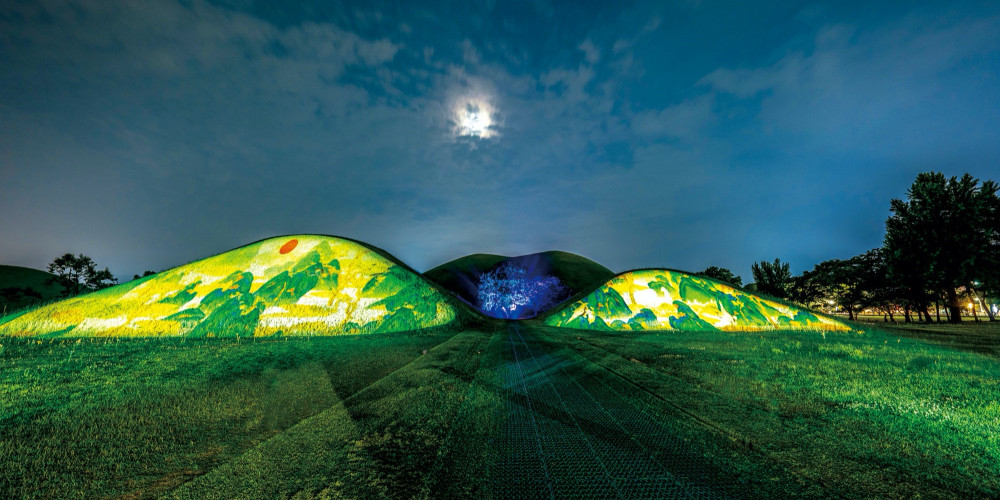
Shaping the Future through Tradition, Gyeongju
On the breath of a thousand-year royal capital, the world gathers. As the host city of the 2025 APEC Summit, Gyeongju weaves its royal tombs, heritage and art into a stage for shaping the future.
From October 31 to November 1, Gyeongju will host the 2025 Asia-Pacific Economic Cooperation (APEC) Summit. The ancient Silla capital, which boasts several UNESCO World Heritage sites, feels perfectly fitting to welcome heads of state, business leaders, ministers and journalists from 21 member countries. After all, Silla was once an international metropolis, its name known even in the distant lands of the West.
Global City of the Ancient World
In his work, The Book of Creation and History (966), the Arab geographer al-Maqdisi wrote: “Those who enter [Silla] do not wish to leave, for its air is pure, its wealth is great, and its people are gentle.” And in the section on King Wonseong (r. 785 – 798) in the Samguk Yusa (Memorabilia of the Three Kingdoms), there is a passage about a Tang Dynasty envoy who brought two men from Hexi (a region in northwestern China) to stay for a month. Some scholars believe these men were Uighurs or Sogdians, key players along the Silk Road. The stone statues of civil and military officials that guard the tomb of King Wonseong are the first of their kind found at a Silla royal tomb depicting what some believe to be an Iranian and a Uighur. The diadem worn by the military figure was a mark of nobility in the ancient Sassanid Dynasty of Persia.
The rulers of Silla, a kingdom that lasted nearly a millennium (57BC – AD935), were remarkably open to the exotic. Between the 4th and 6th centuries, they were already importing Roman glass from as far as the eastern Mediterranean, and a golden dagger encrusted with garnets, a gemstone primarily found in Eastern Europe, was discovered as a funerary object. The great tombs of the six Kim clan kings from this period, known as the Maripgan Period (356 – 514), are clustered together in the Daereungwon Tomb Complex, not far from the old Silla palace site in the heart of Gyeongju. Whenever one of these tombs was excavated, dazzling, foreign-influenced golden artifacts emerged like a small earthquake of treasures, filling the nation with a profound sense of pride and wonder.


© Gyeongju National Museum
Living Museum in the Form of a City
For the first-time visitor to Gyeongju, the most striking sight is likely to be the countless royal burial mounds that rise like gentle green hills throughout the city center. Though the tombs were numbered up to 155 during the colonial era, there are actually over 800. Gyeongju is a city where any excavation work almost guarantees the uncovering of some ancient artifact, a veritable open-air museum that could rightly be called Korea’s Luxor.
The Daereungwon Tomb Complex is the very root of Silla’s DNA, its identity etched in the tens of thousands of treasures buried with its kings. Nearby are the tombs of Noseo-dong. Among them is the Geumgwanchong or “Gold Crown Tomb” — the first tomb to be formally excavated after golden artifacts were accidentally discovered during construction of a building. Visitors entering Geumgwanchong, which earned the moniker “Tutankhamun’s Tomb of the East” for some 40,000 items unearthed from it, can get a fascinating look at the construction of a Silla burial mound.
Gyeongju has long been a wellspring of inspiration for artists. In celebration of the APEC Summit, the Gyeongju Arts Center’s Alcheon Art Museum is holding an exhibition titled Modern and Contemporary Korean Art: The Four Masters (running until October 12), which shines a light on another facet of the city’s rich artistic history. The exhibition features art by Kim Whanki, Park Soo Keun, Lee Jung-seob, and Chang Ucchin. Park Soo Keun’s paintings are particularly notable for their simple, honest depictions of ordinary life, permeating a sense of Eastern restraint. His trademark is his rough, granite-like texture or matière, which he achieved by applying as many as 22 layers of paint. Park, who visited Gyeongju often during his lifetime, was said to have been captivated by ancient Buddhist statues. He once said that his calling was “to paint the goodness and truth of humanity,” a mission he discovered through Silla’s ancient granite Buddhas.


Time, Blossoming on Foundation Stones
In 553, King Jinheung, the 24th monarch of Silla, had intended to build a new palace east of the Wolseong Fortress. But when a yellow dragon appeared on the site, he instead decided to build a temple, naming it Hwangnyongsa (“Yellow Dragon Temple”). The temple was completed 17 years later, and it housed a massive gilt-bronze Buddha statue weighing over 21,000kg. Then, in 645, during the reign of Queen Seondeok (Silla’s 27th monarch), a magnificent wooden pagoda soaring 80m high was added, designed to ward off and intimidate the nine enemy tribes that surrounded Silla. The completion of this pagoda marked the culmination of a nearly century-long national project spanning four different reigns.
It was Silla’s greatest and most sacred national temple. This holy site was burned to the ground during the Mongolian invasion of 1238. It is said that the smoke and ash blackened the sky for several weeks. Time scarred the land, and the hooves of enemy horses trampled it, but the deep-rooted foundation stones remained. Han Jeong-ho, a professor of art history and archaeology at Dongguk University Gyeongju, spent his student holidays in the 1980s helping to sort artifacts at the Hwangnyongsa Temple Site Research Center. He learned that the area was once full of dolmens, and many of these ancient megaliths had been cut down and used as foundation stones for the temple — Bronze Age dolmens reused as foundations in the Silla Kingdom. All things come full circle.
The Hwangnyongsa Temple Site today feels endlessly peaceful. Violets and dandelions in the spring, daisies and orange cosmos in the summer and fall, all blooming in a riot of color between the ancient stones. Gyeongju is not a place to be built up and filled, but to be emptied, a letting go of all that is non-essential to return to the source. “Have not the foundation stones of Hwangnyongsa, having carried their heavy pillars for so long, been laid down to an extended rest?” the professor muses. Even today, he often visits the site, engaging with the spirits of the past. This beautiful ruin, so full in its emptiness, has a way of turning an art historian into a poet.
As I walk from Hwangnyongsa toward Gyeongju National Museum, my thoughts drift, with a certain longing, to the Maitreya Buddha Triad known as the baby-faced Buddhas. The main Buddha, seated on a stool, gazes gently downward. The gentle curve of his eyebrows, a round face with the hint of a smile, and his chubby palm all give him the innocent look of a child.
The two attendant bodhisattvas at his side have the proportions of newborns, their heads making up a quarter of their height. With pure, smiling faces, they radiate a feeling of pure blessing. The bodhisattva on the right, who holds a lotus bud to his chest, has his left knee slightly bent and the tip of his toe lifted in a pose of exquisite charm. “A soft, gentle expression rendered in hard granite — a style unique to Silla,” the description explains. The innocent purity of the Three Kingdoms-era Buddhas — is this not the original archetype of the Korean soul? A poet once wrote, in a travelogue of Gyeongju, of “a nostalgic yearning of the body, come in search of the soul’s origin.” Gyeongju remains home to my soul, a place that exists nowhere in reality.


- Written by. Kang Seukkyong
Kang debuted as a novelist in the monthly magazine Munhak Sasang (Literary Ideology) in 1974. Through her unique literary world, forged from years spent living in and observing Gyeongju, she has built a one-of-a-kind presence in the Korean literary world.
- Photography by. Jo Jiyoung

© Shin Gyuchul
Gyeongju, Where the World Meets
APEC 2025 KOREA
This fall, Gyeongju takes center stage as the host of the APEC Summit. In this ancient Silla capital where the past and future so gracefully converge, Korea will address APEC’s vision for shaping the future under the theme, “Building a Sustainable Tomorrow: Connect, Innovate, Prosper,” and lead the way in realizing its long-term goals. The highlight of the forum, the APEC Economic Leaders’ Meeting (October 31 to November 1), will bring together heads of state and top business leaders from member countries to shape the agenda for the years to come.
Welcome to Gyeongju
Gyeongju was the capital of the ancient Silla Kingdom and remains a potent symbol of Korean culture, with UNESCO World Heritage Sites like Seokguram Grotto, Bulguksa Temple and the Gyeongju Historic Areas gracing its landscape. The year 2025 also happens to mark the 30th anniversary of Seokguram and Bulguksa’s designation as UNESCO World Heritage Sites, making this a perfect moment to reflect on Gyeongju’s thousand years of cultural heritage against the backdrop of APEC’s global stage. The main venue for the summit will be the Hwabaek International Convention Center (HICO) at the Bomun Lake Resort Complex, its very name a tribute to the Silla Kingdom’s council of nobles, the Hwabaek. The official state dinner will be held at the Gyeongju National Museum, a place where the cultural treasures of the Silla Kingdom are lovingly preserved.

© HICO
Bridging the Past & Future
The area around the main venue at the Bomun Lake Resort Complex will feature a massive egg-shaped sculpture that tells the story of Bak Hyeokgeose, the legendary founder of the Silla Kingdom. The evenings will be aglow with nature-inspired media art, including commemorative benches for the 21 APEC members and beautifully illuminated trees.
A rich array of cultural programs will also be on offer. To commemorate the gathering of world leaders, the Gyeongju National Museum will hold a special exhibition featuring golden crowns once worn by Silla’s monarchs, offering visitors a chance to encounter the royal splendor of a thousand years ago. In addition, Gyeongju will host a range of events across the city, including the World Heritage Festival (September 12 to October 3) and the Gyeongju Cultural Heritage Night tour (September 26 – 28).


© GYEONGSANGBUK-DO CULTURE AND TOURISM ORGANIZATION


