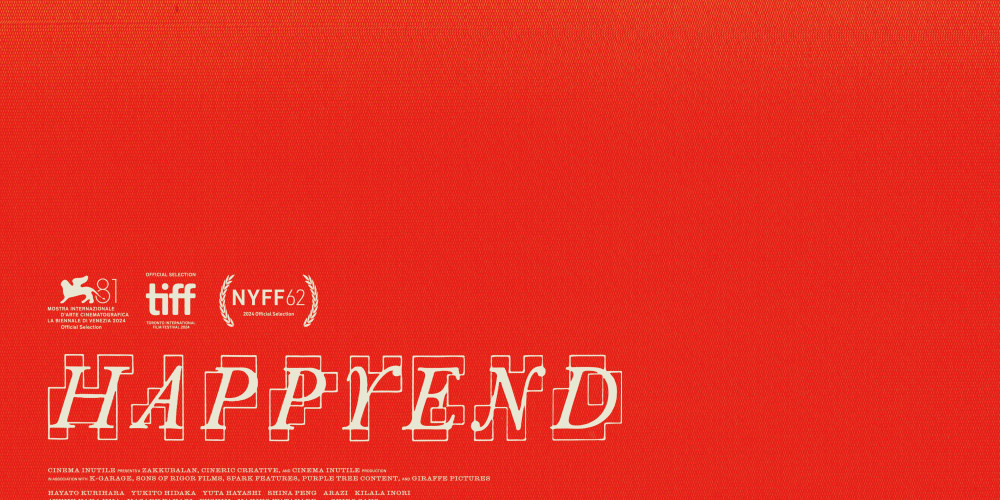
Happyend(ing)
Prominent Korean film critic Jung Sungil shares his recommendation of movies to watch while flying.
I hesitated for a moment when I saw the title: Happyend. I braced myself. A title like that usually spells tragedy. What kind of devastating finale, I wondered, could justify such an auspicious name? Fortunately, the film didn’t conclude in the manner I had feared. But as the credits rolled, I was left in that wonderfully ambiguous space between happiness and tragedy, a quiet question lingering in the air. Let this be a gentle warning: this is not a film to be started and stopped lightly. So as you settle into your flight, you might want to schedule your viewing accordingly.
As a critic, I believe that positioning a film too close to a director’s personal life can often get in the way of a true appreciation of the work. But some films are exceptions to the rule, and Happyend is one of them. Though the director, Neo Sora, has always denied it, this feels like a deeply personal film.
Neo Sora’s father was the legendary musician Ryuichi Sakamoto. Hearing this, the first question that naturally arises is why their surnames are different. At the time of Neo’s birth, Ryuichi Sakamoto was still married to the musician Akiko Yano. Neo’s mother, Norika Sora, was Sakamoto’s manager. There’s no need to elaborate the details. Neo grew up between New York and Tokyo, and after graduating from university, he began his career in translation and filmmaking. At his mother’s request, Neo would go on to direct Ryuichi Sakamoto: Opus, the beautiful final performance documentary of his father, filmed while he was battling cancer.
From here, perhaps what I’m offering is less a critique and more a work of fiction. Happyend is filled with quiet traces of what feels like a son’s search for his father, a question gently unfolding: just who was this man? The story centers around five high school friends — Yuta, Kou, Tom, Ming, and Ata — in a music appreciation club. They’re obsessed with electronic music and techno, and Yuta and Kou dream of moving to Detroit to become DJs. If hearing this makes you think, ah, this director knows his stuff, you’re probably an EDM fan. Detroit is the holy land of techno.

But I want to go a little deeper. The first point of connection: Ryuichi Sakamoto was a musician. Happyend is a story about young people who love music. The second strange thing: although the five friends seem to take little notice of it themselves, their club is remarkably diverse. Kou is a fourth-generation Zainichi Korean (ethnic Korean population in Japan), living with his single mother who runs a local Korean restaurant. Tom is visibly of mixed Black heritage; his father lives in America, and at the end of the film, Tom leaves to join him. Ming is Taiwanese, living in Japan with her family, likely for the long term. She confides that for her to speak to her father in Chinese, her mother needs to interpret. Yuta, too, has a father living in America, though he never speaks of it directly. Only Ata, the club’s resident troublemaker, seems free from this thread of displacement. In this Japanese film, the characters seem to view Japan with the eyes of an outsider, or they end up leaving it.
The third strange thing: Yuta and Kou are raised by their mothers. Yuta’s mother goes to America to visit his father, leaving Yuta at home. Kou, of Zainichi Korean heritage, has no father at all. And Tom says his goodbyes to go and meet his father in America. In a touching scene, Ata is invited to have lunch with Ming’s Taiwanese parents, a gesture that seems to be a formal introduction, but the film doesn’t follow them there. In a film about five friends, not a single one of their fathers ever appears on screen. The film seems to be actively avoiding a direct confrontation with the figure of the father. To put it more plainly: Neo Sora seems to be avoiding a direct confrontation with his father.

So where, then, can we find Ryuichi Sakamoto in Happyend? Kou starts attending meetings for a social reform group and finds himself drawn to the radical ideas of a girl named Fumi. But when Fumi and her friends decide to stage a protest by occupying the principal’s office, Kou doesn’t join them. Instead, he brings them his mother’s homemade kimbap to sustain them through the night. Let’s pause the film for a moment. Think of Kou and Fumi, both in their last year of high school. Now, what was Ryuichi Sakamoto doing at that age?
In 1970, Japan was in the midst of a politically charged era. In 1968, students had taken over the Yasuda Auditorium at the University of Tokyo, occupying it for months as part of the 1968-69 Japanese University Protests. The government eventually sent in 8,500 riot police and helicopters to arrest them all. That event was followed by protests against Prime Minister Sato’s visit to the U.S. In 1970, protests against the U.S.-Japan security treaty renewal began. At eighteen years old, Ryuichi Sakamoto and a group he belonged to took part in the protests. In an act of solidarity, they occupied and barricaded their own high school in Shinjuku.
With this knowledge, the scene in Happyend takes on a different light. The protest scene is devoid of any real excitement, nor does the film seem to endorse it. This begs the question: what is it really about? It’s filled with an odd, poignant loneliness. It almost feels as though Neo Sora, the son, is speaking to his eighteen-year-old father across time, saying, ”I don’t really understand what you were fighting for, but I wanted to feel, just for a moment, the loneliness you must have felt back then.”
Of course, Neo has wrapped this gesture in multiple layers of deflection. He sets his film not in the politically charged 1970s, but in the near future, giving it the feel of a subtle sci-fi movie. For an audience unfamiliar with the history, it would be difficult to connect the two. And yet, for a film set in the near future, it’s steeped in a strange sense of nostalgia. The student who leads the protest is not one of the main group of music lovers, but an outsider, Fumi, a female student. It’s not easy to layer the image of a teenage girl over the image of Neo’s father. In a sense, Happyend is a self-effacing cinematic journey. It’s a film that asks not to be analyzed logically, but to be felt. If you listen carefully for the gentle, tender conversations happening just beneath the surface, you’ll find you can get much closer to the heart of it.

After the quiet commotion of the protest subsides, graduation arrives. The friends from the music club, who once believed their time together would be endless, must now go their separate ways. Even Yuta and Kou, who dreamed of going to Detroit together to become DJs, say their goodbyes on an overpass and walk off in opposite directions. For some, this parting scene will be deeply moving, while others might find it a little anticlimactic. To put it another way, this ending might be a profoundly sad, yet touching ”Happyend-ing” for some. Others will find it to be colorless. To explain it any further would be to interrupt a conversation I hope you are just beginning to have with the film.
One last thing. Ryuichi Sakamoto passed away on March 28, 2023. Sadly, he never had the chance to see Happyend, the film his son made. If he were still with us, what might he have said about this final scene? Or more importantly, what conversation might he and Neo Sora have had?
-
Jung Sungil is a film critic and a director. He played a crucial role in shaping cinephile culture in South Korea in the 1990s by leading Kino, a magazine that transformed the landscape of film criticism.
-
Available content may vary depending on your flight.


A New Wave: Jung Sungil on the Japanese Cinema of Today
Desert of Namibia (2024)
(Directed by Yoko Yamanaka)
At just 28, Yoko Yamanaka has made her second film, and it is, in the best possible sense of the word, wonderfully unhinged. Kana, a young woman, drifts between two boyfriends. She knows that something is wrong with both choices, but she can’t quite put her finger on what it is. Frustration builds, tempers flare, she fights and fights harder, and through it all, she only grows lonelier. Actress Yumi Kawai delivers a stunningly raw, fearless performance.
Plan 75 (2022)
(Directed by Chie Hayakawa)
In this dystopian sci-fi film set in a society where the government encourages its citizens to opt for euthanasia once they reach the age of 75, a program dubbed “Plan 75,” the premise may seem a bit familiar at first, but the film weaves its disparate storylines in a way that becomes truly extraordinary. The final sequence, which follows the gentle, fading light of the sun, captures the beauty of the twilight years, like a poignant landscape painting.
Missing (2021)
(Directed by Shinzô Katayama)
A poor father and his young daughter are getting by until one night, after seeing a news report about a serial killer, the father remembers seeing the very same man on his way home. After heading out to find the killer, he goes missing. His young daughter then sets out to find her father
by tracking down the serial killer herself. But the world is not so simple.
Amiko (2022)
(Directed by Yusuke Morii)
Amiko is a young girl who lives in a small coastal town. Both quirky and imaginative, her behavior shows her to be distinctly different from her peers. She often calls out to the world as if sending a message on a two-way radio to a place that will never respond: “This is Amiko,” she says, waiting for an answer. The film is consistently moving, but it never once falls into the trap of sentimentalism.
MOVIE PREVIEW
Mission and Action


Mission: Impossible ― The Final Reckoning
Ethan Hunt (Tom Cruise) is back for his final mission. This time, the target is the Entity, an unknown, all-powerful AI that has compromised the world’s entire digital infra- structure, threatening humanity’s future. With all digital information now corrupted, nations and individuals alike have no idea what — or who — to trust. Global animosity and martial law have become the new world order. Is the truth we see simply another layer of manipulation, or is truth itself the real threat?
Karate Kid: Legends
Li Fong (Ben Wang), a gifted young kung fu prodigy from China, finds himself starting over in New York City after a tragic accident takes his family. Filled with trauma, he begins a new journey under the guidance of two legendary masters — the kung fu legend Mr. Han (Jackie Chan) and the karate expert Daniel LaRusso (Ralph Macchio) — blending their disciplines to forge a powerful new style. Seamlessly uniting the worlds of the original Karate Kid, the hit series Cobra Kai, and the 2010 remake, this film is a can’t-miss dose of nostalgia for every generation.


Rogue One: A Star Wars Story
A spin-off from the classic Star Wars saga, this film follows Jyn Erso (Felicity Jones) of the Rebel Alliance, who belatedly learns that her long-lost father, Galen (Mads Mikkelsen), has designed the “Death Star,” a weapon so terrifying it can destroy an entire planet. She is given a special mission: steal the blueprints before the weapon is complete and save the galaxy. But the odds of success are just 2.4 percent. Can Jyn and her band of unlikely heroes get hold of the blueprints and pull off the impossible?
A Trip Beyond Time and Space


366 Days
Miu (Moka Kamishiraishi), born on February 29, only gets a birthday every four years. In 2003, she’s a high school student in Okinawa, and a chance mix-up of MiniDiscs reveals a shared taste in music with Minato (Eiji Akaso). They fall in love and after graduating, they move to Tokyo to chase their dreams together, but Minato suddenly breaks things off and disappears. Twenty years later, a MiniDisc containing a message from Miu finds its way back to Minato.
A Minecraft Movie
Meet Garrett (Jason Momoa), a washed-up former video game cham- pion whose game shop is on the brink of collapse. He and a band of unlikely adventurers find themselves accidentally pulled into the “Overworld,” a blocky landscape facing a terrible threat. They quickly realize that to get back to their own reality, they have no choice but to save this pixelated world.


Ready Player One
In 2045, the virtual world of the OASIS is a utopia where anything you can imagine is possible. When its creator dies unexpectedly, he leaves behind his entire fortune to the first person to find a digital Easter egg by locating three hidden keys. A massive corporation joins the hunt, igniting an epic chase that blurs the lines between the game and the real world.
The Lake House
Leaving her beloved lakeside home, Kate (Sandra Bullock) leaves a heartfelt note for the next tenant. That tenant, an architect named Alex (Keanu Reeves), finds her letter in the mailbox. They soon discover they are living in different times, but they continue to exchange letters, their feelings growing deeper.
#K-블랙


Dark Nuns
A young boy is in the grip of a powerful evil spirit. He is being treated by Father Paolo (Lee Jinwook), a psychiatrist who doesn’t believe in the supernat- ural, but Sister Yunia (Song Hyekyo) is convinced that an exorcism is the only way to save him. With the help of Sister Michaela (Jeon Yeobeen), Yunia defies the church’s laws, which forbid an unordained person from performing an exorcism, and begins the rite herself.
Holy Night: Demon Hunters
One Christmas night, a series of bizarre and terrifying incidents plague the city. The “Holy Night” team, a special unit of demon-hunting exorcists, is called in. When a neuropsychiatrist named Jungwon (Kyung Soojin) asks them to exorcise her younger sister, Eunseo (Jung Jiso), they soon realize they are facing a power unlike any they have ever encountered.


Somebody
Single mother Yeongeun (Kwak Sun young) finds her world crumbling around her due to the strange and disturbing behavior of her daughter, Sohyeon (Ki Soyu). Twenty years later, we meet Min (Yuri), a woman who cleans up the apartments of people who have died alone, her past a complete blank. When a mysterious intruder named Hae yeong (Lee Seol) appears in her life, Min is gripped by an unexplainable anxiety as forgotten memories and traces of Sohyeon begin to surface, cracking her carefully constructed life wide open.
Exorcism Chronicles: The Beginning
For centuries, the existence of Haedong Milgyo, a secret religious sect, was unknown to the world. Now, its 145th leader plans to dominate the world by sacrificing the living to gain absolute evil power. To stop him, a team of four exorcists, each with a different past and a unique ability, must band together.
#Reality is a Stage, Life as Theater


Lobby
Startup CEO Changwook (Ha Jungwoo) is constantly losing bids to a rival company that has mastered the art of lobbying its case through backroom schmoozing. He’s a man who has always believed that research and development were all that mattered, but to win a massive government contract, he has no choice but to become a lobbyist himself.
Napoleon
In the chaos of the French Revolution, Napoleon Bonaparte (Joaquin Phoenix) rises as a military hero, eventually crowning himself emperor. But the film also delves into a side of him history has often overlooked — his passionate, turbulent love affair with Joséphine (Vanessa Kirby) and his more human vulnerabilities.


See How They Run
A film adaptation of the hit play The Mousetrap is in the works in London’s West End theater district in the 1950s, when the director, Leo (Adrien Brody), is murdered backstage. Inspector Stoppard (Sam Rockwell) and the eager rookie Constable Stalker (Saoirse Ronan) are called to the scene, to catch the suspect in a theater overflowing with clues and potential culprits.
The Good Liar
Roy (Ian McKellen), a brilliant career con artist, meets the retired wealthy widow Betty (Helen Mirren) on a dating site. His plan is simple: win her heart, then make off with her fortune. But Betty, it turns out, is not as naive as she seems. As their relationship deepens, the line between lies and truth blurs, and soon it’s unclear who is conning whom.
- Available content may vary depending on your flight.