
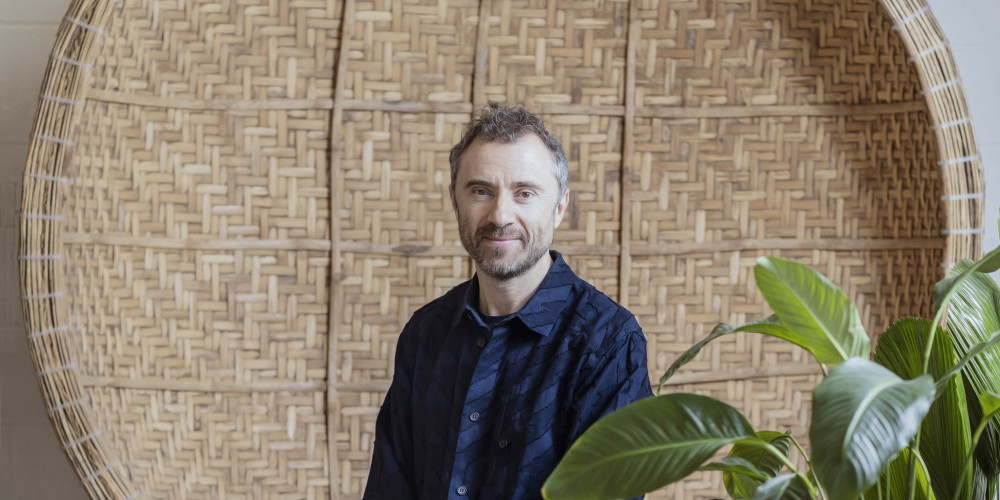
Cities: For the People & By the People. Designer Thomas Heatherwick
Thomas Heatherwick is a creative genius and building designer who tackles the epidemic of boring buildings and advocates building structures that will last for 1,000 years. Named the General Director of the Seoul Biennale of Architecture and Urbanism 2025, we sat down with Heatherwick and Jiyoon Lee, a global art director and long-time collaborator who played a pivotal role in introducing Heatherwick to the Korean public.

Humanizing Building Facades
Q. Thomas, you have been selected to take on the role of General Director of this year’s Seoul Biennale of Architecture and Urbanism, which is taking place from September 26 to November 18. The theme for the fifth edition is “Radically More Human.” What does it mean for architecture to be more human?
Heatherwick⎮ We’ve had a catastrophe around the world. In cities and towns everywhere, we’ve been making unhealthy buildings from a mental health point of view, but also when society doesn’t care about buildings, we demolish them. So we are much more likely to accept the demolition of places that are characterless. And I use the expression in English (it won’t work in Korean) “Blandemic” — places that don’t encourage us to linger, to have fascination. Right now, building designers tend to put a lot of care into buildings like opera houses or art galleries, but much less into the everyday buildings that surround us. So the “Humanise” campaign is really about everyday buildings that surround us everywhere. The average age of a commercial building in South Korea, I’ve been told, is approximately 30 years. In the U.K. it’s 40 years, and the environmental impact of demolishing buildings is immense. And so this is about making the world around us better, more engaging, more generous, but it also has a serious health and environmental dimension.
Q. Jiyoon, you’re the Project Director of the Creative Communities Programme for the Biennale. Can you tell us a bit about this?
LEE⎮ This Biennale in particular is very interesting because normally, a Biennale [is organized by] the curator, director and artists, all professionals in their field. But this time, it’s the real citizens of Seoul participating. It was not an easy process because we had to do open calls. We were trying to select all the creators from Seoul, but we had more than 20,000 people from abroad [who applied]. We had to say no and then we selected only 9 creative community groups out of some 800 applications. Talking with nine groups of people on Zoom and [holding] offsite meetings was challenging, but that was the really inter- esting part — to hear about their Seoul, their experiences. Then, Thomas asked them to make a “Humanise Wall.” Their challenge was to produce one interesting facade image [that depicts the type of city they want to live in]. These nine groups of people are representatives of the city, so with their ideas we made the Humanise Wall: a gigantic sculpture. It will be really amazing to see those messages [come] out of the people who live in Seoul.
Sparking a Seoulful Dialogue
Q. Thomas, what was your first impression of Seoul and how do you want the city to be impacted by this “public conversation?”
Heatherwick⎮ There’s a global curiosity about South Korea, which is exciting, and Seoul is its capital and sort of energy hub. I was speaking to a top art curator and a top sculptor in the U.K. and said, “Where’s the most exciting city in the world for you at the moment?” Both of them, separately, just said, Seoul. I had the chance to spend time in some of the historic buildings and I stayed in one of the hanoks for a week. I was just loving all the tiny human scale detail, and I felt very inspired both by the history, the current, the character of South Korean energy and also the science and technology. So it feels like you’ve got this mix, but there is [this] confidence to keep inventing the future. South Korea has got that energy of moving forwards, so I personally get very energized when I come. Korea leads the world in being modern. And Korea, at this moment, by even holding a Biennale that’s so public, is leading the world in saying, “Let’s have a conversation that doesn’t normally happen.” If anyone can work out how to make cities and buildings that are more engaging, that involve society, I know it’s South Korea.
Q. Jiyoon, you’ve known Heatherwick for many years and in 2023, you curated a major exhibition of Heatherwick Studio’s works in Seoul and played a major role in introducing Heatherwick to the general public. How has it been working closely with him?
LEE⎮ It was really amazing working with Thomas. I was very happy to bring that exhibition to Seoul, which was not only for the elite, not only for the architects — it’s for everyone. He is a world famous designer and in a conversation we once had, he said making his own team was his great achievement, not a big architecture project, which I really respect. When I was working as the Deputy Director of the MMCA Seoul (around 2014 or 2015), he said “I’m going to make a garden bridge right next to Waterloo. There will be a walking bridge and then there will be a Korean garden.” I used to live in London for 25 years so I know Waterloo very much. He said why don’t we look for some fundraising for the Korean garden and I was so happy. And that was really a beautiful moment. I saw his vision and his love [to] make the city humanized. I was so honored to be able to deliver his philosophy to Seoul.

Q. As the designer behind a long list of iconic buildings around the world, your studio will leave a mark on Korea’s capital city with a number of projects including Nodeul Island, Hanwha Galleria, Coex and the redevelopment of apartments in Yeouido. How do you see your buildings sparking joy and engagement from the public?
Heatherwick⎮ Nodeul Island is a platform, really. And we’re just trying to supercharge that platform for the creativity of Seoul citizens. It’s like an amazing picture frame for the artwork that is the people of Seoul. My hope is that my projects are good encouragements rather than full stops. They’re there to symbolize a journey, not to be the whole journey. These projects are to try to encourage everyday projects to feel the everyday needs, little moments of magic, not just the big ones. It’s all about the small — encouraging the creativity of thousands of people. That’s what mustn’t be missed in this.
Q. We live in a time of climate crisis and widening divides across all areas of life. As a building designer living in this age of hyper-urbanization and technology, what emotions do you feel when looking toward the future?
Heatherwick⎮ You’re asking the wrong person because I am wired to be an optimist and to be hopeful. But they say don’t try and predict the future, invent it. It’s our job together to invent the future that we want and make it happen. In a way, all I am is a very determined person. There are a lot of people a lot more creative than I am, but I just keep going and going because I think the world isn’t about genius moments. It’s about being willing to carry through the hard work it takes to try to improve things. The biggest reward is when you feel that you’ve given someone a high point in their day, or where they work, where they live, a place to come together with family [and] feel less isolated. So this, being in public service — these two words have not been used in architecture. In the art world, you can buy a painting and have it in a rich person’s house or in a gallery, but [in] the world of the buildings you can’t get away from them. You have to live with it. And so we need a whole industry to consider ourselves as being in public service, putting ourselves below the broader society. To say, my job is to try to give something that can be cherished and valued. You can’t make everybody happy, but your heart and your mindset can be really interested in what it takes to do that.
- Thomas Heatherwick is an innovative and creative designer who pursues human-centered architecture. Showcasing unique and dynamic projects around the world, his philosophy, which emphasizes environmental and social responsibility, views architecture not merely as structures but as a form of public service. Appointed as the General Director of the Seoul Biennale of Architecture and Urbanism 2025, he is engaging with the Korean public to explore the future of cities and architecture.
- Jiyoon Lee has been running SUUM Project, a global contemporary art exhibition planning office based in London and Seoul, for the past 20 years. She curated the 2023 exhibition Heatherwick Studio: Building Soulfulness held at Culture Station Seoul 284, and serves as the Project Director of the Creative Community program alongside Heatherwick for the Seoul Biennale of Architecture and Urbanism 2025.
- Written by. Jennifer Chang
- Photo Courtesy of Heatherwick Studio and SUUM Project


