A Wonderful Day When Nothing Goes to Plan
MorningCalm presents Omnibus Story, a series of reflections drawn from the landscapes of everyday life, explored from diverse perspectives. Our hope is that these narratives linger as seeds of inspiration, blossoming throughout your journey when you least expect them.
- Baek Youngok is an author known for her delicate prose exploring love, loss and consolation. Her numerous works include Style — winner of the 4th Segye Literature Award — To My Lover’s Lover and Seven O’Clock Breakfast Club for the Brokenhearted. Her bestseller, What Anne of Green Gables Says, deeply resonates with readers, bringing the timeless, comforting wisdom of Anne of Green Gables to modern readers.
Among the many passages I read long ago, one line anchored itself in my mind: “For a long time it had seemed to me that life was about to begin — real life.” It was a quote by Alfred D’Souza. He believed that once the obstacles, unfinished tasks and debts were cleared, his real life would finally commence. And then, at last, he understood: those obstacles were his real life.
I still haven’t forgotten the shock of reading that line for the first time. As a child, I treated life like a trailer for a movie that hadn’t yet begun; I believed the main feature was waiting somewhere in the distant future. The place where I first began thinking this way was my elementary school library, where my true friends were books. And there, lonely and quiet, I met Anne for the first time at the age of nine. To me, she was a red-headed orphan brimming with imagination and constantly misunderstood, waiting for the day she would meet someone who truly understood her. Back then, I felt uncomfortable living in reality but found a sense of safety in my imagination.
So storytelling drew me in naturally. When there were no more books left for me to read in the library, I decided to write my own. At the age of 14, using a blue Monami ballpoint pen, I began scribbling stories into a simple Barunson notebook. My classmates became my very first readers, eagerly waiting for the next chapter. Back then, I was already a writer, crafting stories about waiting for a boy like Gilbert, before I had ever met a Gilbert myself.
Yet becoming a “real” writer in adulthood proved far more difficult than I had envisioned. Over the course of 10 years, I failed to win accolades in nearly a hundred literary contests. Even after speaking publicly, I would secretly hide in bathroom stalls just trying to catch my breath. Each time, I consoled myself with the belief that my real life had simply not begun yet.
What went off-script was precisely what carved out a path for me. When I ultimately won a rookie literary award, instead of a polished acceptance speech, I drew up a complete list of all the contests I had failed to win. That record of failure caught the eye of a literary reporter, which led to a newspaper column. The first opportunity that came my way in life didn’t come from success but from honestly confronting and laying out my failures. I came to realize that the very things I had considered obstacles were actually shaping the story of my life.
Making the journey to Prince Edward Island had been on my bucket list for over 30 years, a dream that began in that library when I was nine years old. It was a plan that always got pushed aside by practical concerns: it was too far, too expensive and too much work. But when I finally boarded the plane, I realized it was even farther than I had imagined. I flew to Toronto, then transferred to a flight bound for Halifax.
From Halifax, I took a bus across the Confederation Bridge and arrived on Prince Edward Island at long last. My first impression of Charlottetown was that it was modest and quiet. To Anne in the novel, it is a dazzling city, but the real Charlottetown was small, gentle and endearing, which I loved all the more. Posters for the Anne & Gilbert musical adorned the streets, and souvenir shops were filled with Anne’s face and quotes. Pollen drifted through the air like snow, not the harsh flakes of winter but a playful dust scattered by spring. Purple, pink and white blossoms bloomed across the island. When someone told me the flowers were called “lupins,” I thought it sounded like the name of a magician.
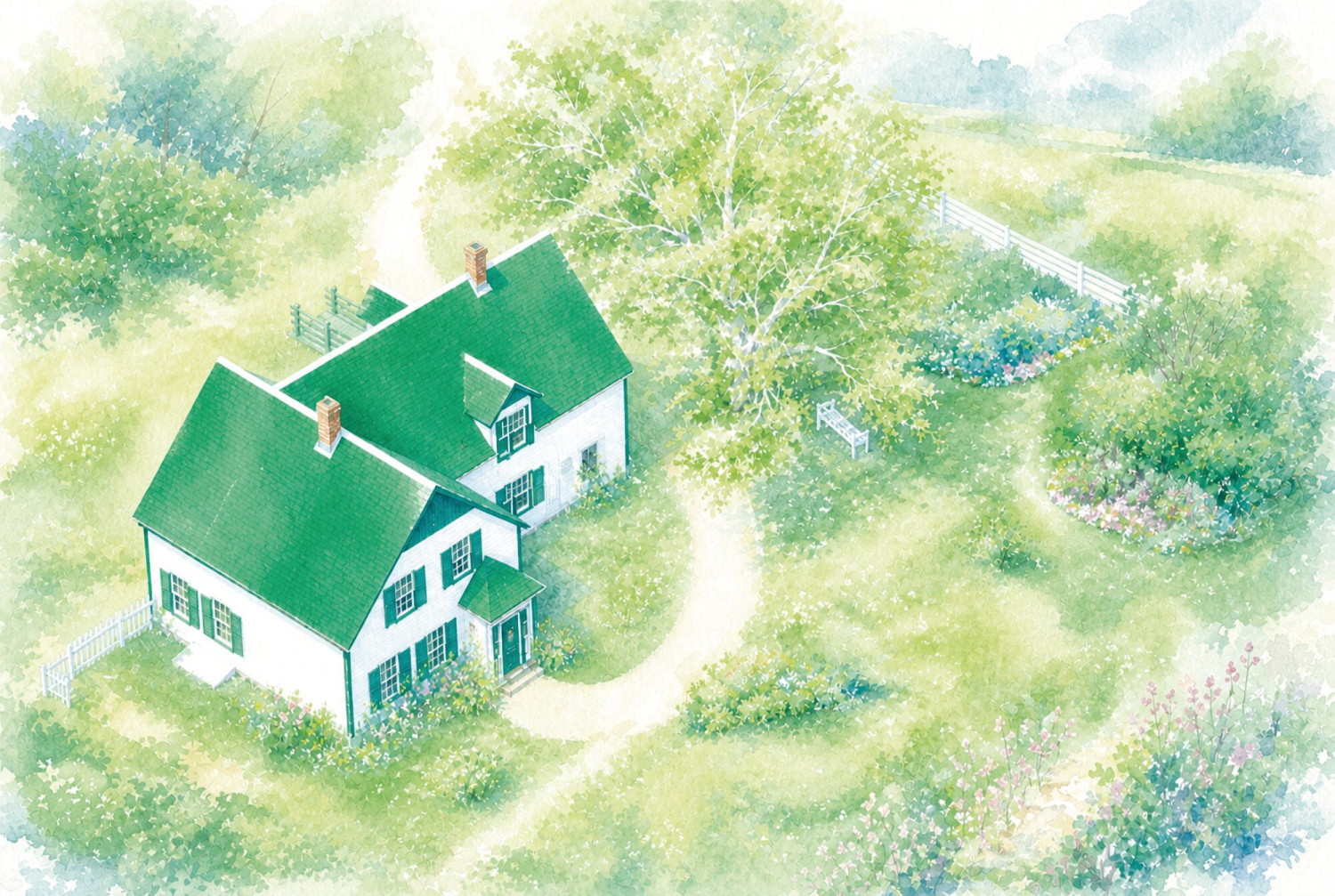
When I finally arrived at the house with green gables, I saw Anne fans from every corner of the globe: silver-haired Annes, black-haired Annes, blonde Annes. Whatever their nationality, they had all brought their own inner Anne along on this journey. One middle-aged woman, dressed in a full Anne-style gown, was twirling cheerfully around the perimeter of the house. At first I was surprised, then I smiled and then an unexpected lump formed in my throat.
I realized that no matter how old we get, we keep our inner child alive — it’s just that in daily life, we rarely have an appropriate outfit to dress them in.
Opening the front door of Green Gables, I felt my mouth curl into a wry smile because the house was so small. I couldn’t tell if the house had shrunk or if I had grown too big. For a moment, I felt like Gulliver in a miniature world, bowing my head just to step inside. Yet curiously, I loved that about it. In such a tiny house, Anne had nurtured such grand dreams! She had given vast names to small rooms and learned high, soaring language under low-sloping roofs. Imagination, I realized, doesn’t only bloom in vast spaces. Sometimes it reaches further precisely because of low ceilings, cramped quarters and frequent collisions with reality.
The most startling thing was finding a lush, green golf course adjacent to the yard of the Green Gables House in the form of the Green Gables Golf Club, a course with more than eight decades of tradition. I let out a sudden laugh. The world is always like this. Right alongside the beloved fantasy held dear for decades, a real-life golf cart drives past. Flags are planted, someone is putting on the green and tourists are buying souvenirs. The fairytale hadn’t conquered reality; it was simply growing old alongside it.
I walked down Lover’s Lane and passed through the Haunted Wood Trail, just as Anne and Diana imagine it. A stream glinted quietly beneath the trees, and every turn of the red dirt path opened onto alternating views of green fields and the river. At the old Cavendish Post Office, where Lucy Maud Montgomery had once helped her grandmother sort the mail, I jotted some words down on a postcard and mailed it back home to Korea.
Those few days were filled with pure happiness. Yet as I prepared to leave the island, I felt a sense of ease rather than sorrow. A quiet relief washed over me at the thought of returning home — to my own bed, my desk, my favorite daily mug and a simple, unpretentious dinner. Anne feels the exact same way. After staying in Charlottetown at Aunt Josephine Barry’s invitation and enjoying exhibitions, concerts and late-night ice cream, she returns home and declares that the very best part of it all is returning home. She knows that sleeping in her east gable room, listening to the wind singing through the fir trees and watching the stars twinkle outside her window, is where she was most truly herself, far more than during those days in the glamorous city.
I finally understood what Anne means. Perhaps travel is not about journeying far away to find your “true self” but about returning to the self you forgot while struggling to survive. For me, traveling was never really about leaving; it was always about finding my way back home.
Of course, we will keep departing on new voyages. We will board airplanes, buses and trains. But there are also journeys that require no passport: a quiet walk around the neighborhood, opening a long-neglected drawer or discovering a shop on your evening commute that you hadn’t noticed in the morning. Like my friend, who was forced by subway construction work to take a detour down an unfamiliar back alley, only to end up in front of a flyer for flower-arranging classes taped to a telephone pole. That small detour transformed her life: she eventually left her job as a book editor, moved to England and became a florist. By keeping Anne’s spirit alive within us, we can become adventurers at any age. As Anne says: “After all, I fancy it’s the unexpected things that give spice to life.”
I truly believe in those words now. The things that didn’t go according to plan are the very things that brought me to where I am today: the lonely girl in the library, the student writing furiously with a blue pen as an escape, the aspiring writer rejected over a hundred times, the speaker catching her breath in a bathroom stall and finally, the middle-aged woman standing before a tiny house with green gables, laughing at feeling like a giant. Every one of those moments embodied me. Every obstacle along the way helped make me who I am. Staying young, then, isn’t about maintaining a youthful appearance but retaining the capacity to embrace the unpredictable as an adventure. If we preserve that spirit and channel our inner Anne, we become travelers embracing the essence of that red-haired girl while making our way back home every day.
Long after I returned, the postcard I mailed from the Cavendish Post Office arrived in my mailbox. It felt as though I had written a letter to my future self. Reading it that evening, I dreamed once again of Prince Edward Island. The journey, I realized, had continued long after I had arrived home.
- Written by Baek Youngok