
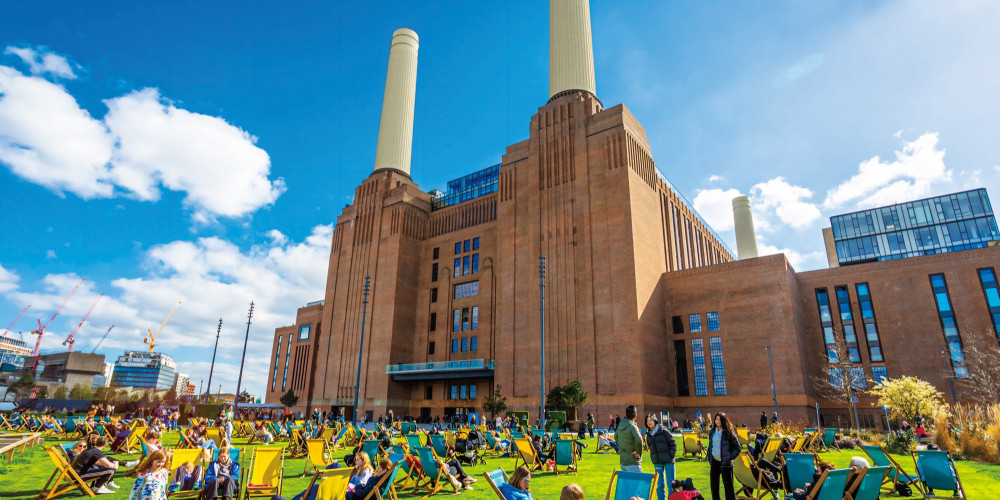
London's New Nexus, Battersea Power Station
Nestled on the banks of the River Thames, Battersea Power Station, a coal-fired sentinel that fell silent in 1983, lay long neglected. Reborn as a vibrant new urban landmark, MorningCalm explore the myriad facets of this remarkable space.


ⓒ Kim Jeonghoo
London’s Hottest Hub
“Where are the ‘hot spots’ most cherished by Londoners?” The answer will invariably point to two distinct locales: Coal Drops Yard in King’s Cross and Battersea Power Station in Nine Elms. King’s Cross anchors the northern heart of the Thames, whereas Nine Elms resides in the southwestern periphery. Between the two areas, many a Londoner would likely choose the latter. Nine Elms, with Battersea Power Station as its gravitational center, offers an enviable confluence of residential, commercial and office facilities, complemented by stunning riverside vistas and expansive green parklands.
Gazing upon the resplendent Battersea Power Station and its environs today, it’s a challenge to conjure up its appearance from just two decades prior. Erected in the early 20th century, the power station remained operational until 1983, thereafter languishing in disinterest. Nine Elms, a quintessential industrial zone developed around this behemoth, garnered little attention. However, when Bankside Power Station was brilliantly reimagined as Tate Modern in 2000 and resurrected as an icon of contemporary art, the vast potential of Battersea Power Station was compellingly brought into a new light.
Shopping Arcade Housed in a Former Power Station
Nine Elms encompasses some 2.3 million square meters of formerly idle land, including Battersea Power Station itself. As one of the last large-scale developable sites within central London, it held the promise of hosting Europe’s largest mixed-use regeneration project, incorporating residential, office, commercial and cultural facilities. WilkinsonEyre Architects focused on conserving the power station’s iconic exterior walls and meticulously restored its chimneys.
Functionally and symbolically, Battersea Power Station presents its grandest facade to the Thames, yet it remains easily accessible on foot from all directions, welcoming visitors into its interior. The perfectly symmetrical layout features two vast turbine halls, now transformed into a multilevel shopping arcade. While the overall ambiance palpably retains the industrial gravitas of the former power station, the infusion of a modern retail environment achieves an exquisite harmony between old and new.
The allure of Battersea Power Station is further magnified by its thoughtfully designed external spaces. Notably, the outdoor piazza and sunken garden, seamlessly connected to the turbine halls, serve as superlative public realms for residents. These areas primarily house shops and amenities catering to the local community, creating an intimate and inviting atmosphere that perhaps surpassed initial expectations. Another magnificent gift bestowed upon the city by Battersea Power Station is the meticulously landscaped riverside park fronting the structure, directly facing the Thames. What was once the power station’s coal yard has been reborn as a vibrant public space for appreciating the river, hosting a diverse array of events and exhibitions.

London’s Evolution
If the 2000 rebirth of Bankside Power Station as Tate Modern unveiled London’s charm as a cultural arts destination revitalized from industrial heritage, then Battersea Power Station, taking up the mantle in 2022, radiates a distinct allure as a repurposed residential and commercial hub. These two power stations, sibling structures born in the 20th century, have, in the 21st century, been magnificently resurrected into vibrant new lives.
The profound lesson offered by the two power stations is the power of reimagining obsolete industrial facilities. These once-utilitarian structures have been imbued with new life, becoming vital anchors for regional growth. Had Bankside not been reborn as Tate Modern, it’s improbable that its surrounding area would now thrum with vitality. By the same token, had Battersea not been re-envisioned as a mixed-use complex, the extensive regeneration currently underway in its vicinity would be difficult to imagine.
Ultimately, though differing in conditions, context, location, scale and function, Battersea Power Station follows in the tradition established by Bankside, serving as a potent catalyst to reverse urban decline and drive London’s sustainable growth. In this manner, London continues its perpetual, inspiring evolution.
Places to Explore Around the Battersea Power Station
Lift 109
A glass elevator within one of Battersea Power Station’s iconic chimneys takes you up to the top offering 360-degree panoramic views of London from a height of 109m. Prior to boarding, visitors can explore an exhibition detailing the power station’s history and cultural significance.
- lift109.co.uk
Battersea Power Station Shopping Mall
Housing some 150 fashion and lifestyle boutiques, a cinema, and a diverse array of restaurants and cafés, this exciting shopping and cultural destination is a comprehensive one-stop experience with regular cultural events and brand pop-up stores.
- batterseapowerstation.co.uk
Battersea Park
This Victorian-era park opened in 1858 and features diverse attractions including the Peace Pagoda, a children’s zoo, the Pump House Gallery hosting contemporary art exhibitions and sculptures by Henry Moore.
- wandsworth.gov.uk/batterseapark
New Covent Garden Market
This is the U.K.’s largest wholesale market specializing in fruits, vegetables and flowers. Open from 4 a.m. each day, the Flower Market offers a vibrant spectacle of colorful blooms and bustling trade, making it an attractive destination to visit.
- newcoventgardenmarket.com
Tate Britain
The oldest gallery in the network of Tate galleries holds British art from the 1500s to the present day. Its collection includes works by seminal artists such as William Turner and Francis Bacon, and it holds significant importance in the art world as the annual host of the prestigious Turner Prize.
- tate.org.uk/visit/tate-britain
- Kim Jeonghoo is an architect and urban sociologist who serves as an advisor and researcher on urban, architectural, and design policies and projects across Korea and the U.K. He currently conducts research and lectures on European and Asian cities at City, University of London, and directs the JHK Urban Research Lab (JURL) in both the U.K. and Korea.
- Written by Kim Jeonghoo
- Photography by Charlie Round Turner
- Images courtesy of Battersea Power Station Development Company
- Korean Air operates direct flights between Incheon and London 7 times a week.


