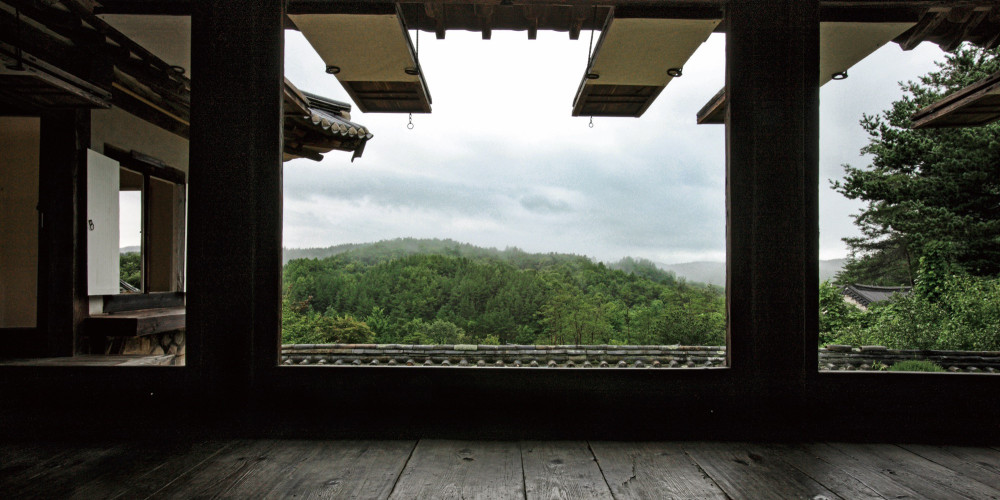
Borrowed Scenery, Chagyeong
Our third exploration into the aesthetic concepts underpinning Korean sentiment, and how they continue to weave through contemporary life, focuses on chagyeong, which signifies the art of drawing the natural world beyond windows and doors into one’s own space. Rather than artificially altering nature, Korean chagyeong embodies an aesthetic consciousness that respects the inherent landscape, subtly and carefully inviting it inward.
- Gradation K is a column that explores, from a contemporary perspective, the aesthetic consciousness imbued with Korea’s unique beauty and style, from its traditional roots to its modern expressions. Our third theme delves into chagyeong (借景), an aesthetic sensibility that reveres nature as it is and seeks harmonious integration with it.
The Korean Garden: Transcending Nature’s Boundaries


Changdeokgung Palace, the most well-preserved of the Joseon Dynasty (1392–1910) palaces, also served as the royal residence for the longest period. Situated east of Gyeongbokgung Palace, it was often referred to as Donggwol (East Palace) and is still distinguished by its architectural layout, which masterfully complements the natural topography of the area. It served as the primary palace until Gyeongbokgung was reconstructed during King Gojong’s reign. Its garden, long known as Biwon (Secret Garden) for its exquisite beauty, contributed to the
palace being designated a UNESCO World Heritage Site.
The act of incorporating nature into human spaces, jogyeong (造景), literally means “to create scenery.” In contrast, chagyeong means “to borrow scenery.” The concept of chagyeong can be seen in multiple East Asian countries. Korea, China and Japan share a number of cultural concepts due in part to the three nations’ use of Chinese characters. This, combined with mutual influence and frequent contact over extensive periods have led to a blending of cultures, often sparking debates about distinct cultural identities.
To offer a concise differentiation between their gardening styles, Chinese gardens are often meticulously elaborate and opulent, with clearly defined layouts and functions. Like a well-structured drama, they possess specific narratives, with distinct activities prescribed for specific locations — for instance, a designated spot for moon-viewing and another for immersing oneself in nature while sharing rice wine with friends. Japanese gardens, on the other hand, tend to be exquisitely miniaturized recreations of nature. They are often appreciated from a set distance, much like admiring a masterpiece
in an art gallery.
In contrast, Korean gardens almost seem to embrace
ambiguity as their guiding principle. The boundaries of the garden are often indistinct, its layout and function deliberately undefined. Like reading an open-ended novel, individuals enter and forge their own spaces and meanings. They become, in essence, creative and proactive readers of the landscape.
Indeed, the act of shaping an outdoor space, planting flowers and trees, is in itself the human creation of another representation of nature. However, the Korean approach emphasizes not the reduction of nature or its confinement within human-imposed frameworks, but rather the gentle permeation
- Written by Roh Eunjoo / Photography by Lee Dong Chun
- Roh Eunjoo is an architect and one of the two founders of studio_Gaon Architects. The pure Korean word gaon (家穩) signifies “center” and also connotes the “tranquility of home” in hanja (Chinese characters used to write the Korean language).
Embracing Chagyeong


Confluence of Templestays and Chagyeong
Chagyeong is a traditional Korean aesthetic that involves “borrowing natural scenery” and inviting it into one’s personal space. Rather than artificially mimicking nature with landscaping, it draws in the distant mountains, the expansive sky, the trees — even the whisper of the wind, just as they are.
This aesthetic of chagyeong naturally resonates with the experience of a templestay today. The crisp dawn air of a mountain monastery, the shadows of a pine forest cast beyond a window, the murmur of water, the chime of a wind bell — these are not merely scenic backdrops but mirrors reflecting the inner world of the practitioner. The moment one sits on the temple’s maru (wooden-floored area connecting rooms) gazing at distant mountains, one is not simply observing an external landscape: one is, in effect, borrowing that scenery and drawing it into the heart.
The minds and hearts of modern individuals often exist in a state of perpetual overstimulation. Amid thoughts and emotions racing at 200km/h, what we often forget is the profound importance of pausing. If there exists a space where one can momentarily step away from the frenzy of daily life and apply the brakes, that, truly, is genuine rest. This is why templestays are experiencing a renewed appreciation. While once perhaps perceived as somewhat traditional or staid, contemporary templestays offer something quite different. The K-templestay, imbued with nature, tranquility, contemplation and rest, are gaining popularity even among overseas visitors. Notably, a summer templestay offers a chance to experience the philosophy of chagyeong in its most sensory and immediate form.
Evolution of K-templestays
The K-templestay, which re-interprets the meaning of traditional practice for a modern audience, is now entering a new phase. These experiences now encompass an astonishing range of activities, from surfing and fasting to martial arts training, and even opportunities for deep connection with pets, offering experiences vastly different from those of the past. Transcending the notion of a simple “temple experience,” they instead propose much-needed forms of rest, recovery and a recalibration of our relationships. Allow me to introduce some unique K-templestays that invite you to welcome chagyeong into your heart.
Naksansa, in Yangyang, Gangwon-do Province, is an ancient temple founded by Buddhist monk Uisang during the Unified Silla Dynasty (668 – 935). Situated near Surfyy Beach, a popular surfing destination in Korea, its daring concept of a surfing templestay has generated a new wave of interest, offering a way to combine surfing and spiritual practice. Meanwhile, Yukjijangsa Temple in Yangju, Gyeonggi-do Province, focuses on cleansing the body. This temple stay centers around fasting, with a program comprising applecarrot juice, moxibustion with mugwort, 108 prostrations and mountain trail walking meditation. This regimen is designed not only to reduce physical burden but also to provide an experience of mental clarity. The practice of subjecting the lower abdomen to moxibustion treatment to raise the body temperature is said to be a healing method that prevents cell aging and boosts the immune system.
For a more dynamic form of practice, one might journey to Golgulsa Temple in Gyeongju. Known as “Korea’s Shaolin Temple,” it is the cradle of seonmudo, a traditional Korean Buddhist martial art. This templestay offers the chance to train both mind and body through this venerable discipline. Practice sessions conducted against the dramatic backdrop of columnar jointed cliffs, and the exhilarating moment of plunging into the sea after training, create an extraordinary experience where body and mind awaken in unison.
And then there are templestays where one can cultivate peace of mind alongside a canine companion. Mireuksa Temple in Jeungpyeong, Chungcheongbuk-do Province, offers a day-trip program called “Daengpeulstay” (a portmanteau of “daengdaeng-i,” an affectionate term for companion dogs, and “templestay”). Pet owners and their furry pals change into temple attire and walk the temple grounds together.
During a chat over tea (chadam) with a monk, there’s even a chance for “canine counseling.” The monk’s heartfelt advice, encouraging a deep connection with one’s companion animal, evokes a profound emotional resonance. Meeting Seokhwaeom, the temple’s resident dog, is an added highlight of this program.
- Written by Shin Iksu
- Shin Iksu is a journalist at the Maeil Business Newspaper, noted by readers for his columns and feature articles that explore the intersections of both Korean and global travel destinations, traditional culture and contemporary sensibilities