
Stepping Beyond Madrid
The capital of Spain enchants the traveler with its inimitable art and energy, but a world of hidden gems awaits to be discovered in the towns and cities around Madrid. Writer Sohn Mina takes us on a journey beyond Madrid’s city limits to show why the most memorable experiences may be found just outside the capital.
- Sohn Mina is a former TV anchor and MC turned travel writer and novelist. In 2004, uncertainty about her direction in life inspired her to go to Spain. After completing a master’s program there, she received the Spanish Order of Civil Merit from King Felipe VI for her promotion of cultural exchange with Korea.
Toledo
The twisting Tagus River encompasses the fortress-like city where the layers of history are etched with striking clarity. Once home to the Roman Empire, the city was influenced in turn by Islam, Christianity and Judaism, making it a microcosm of Spain itself. Stroll through the side streets of the historic quarter, then head to the hilltop observatory Mirador del Valle for a perfect view of the city, including its fortifications and the river running around it.
- TIP Be sure to try the traditional dessert marzipan and Perdiz a la Toledana, a partridge dish prepared in wine sauce.

Segovia
The Old Town of Segovia and its Aqueduct, which has been designated as a World Heritage Site by UNESCO, is just under 30 minutes by train from Madrid Chamartin Station. The city has a dual legacy, influenced both by ancient Rome and medieval Europe. Running through the middle of the city is a Roman aqueduct built over 2,000 years ago, cunningly assembled, without adhesives, of over 20,000 granite blocks. Segovia also boasts the Alcázar, which served as both grand palace and awe-inspiring fortress during the Middle Ages, and the Segovia Cathedral, a gorgeous building considered one of Spain’s last Gothic masterpieces.
- TIP Head to the Mirador del Alcazar y los dos Valles observation deck to soak in the sunset.


Aranjuez
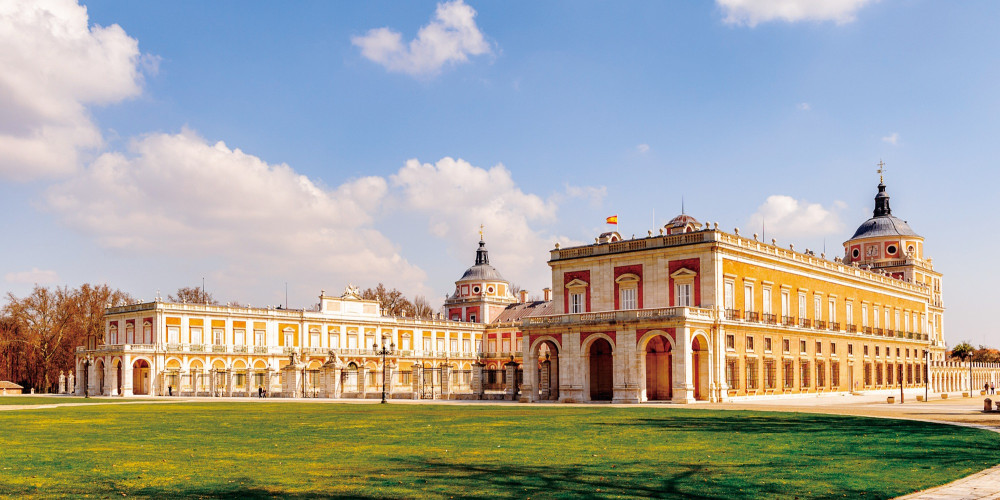
Aranjuez, the garden city adored by the Spanish monarchy, is Spain’s answer to Versailles. The landscape of the city changes with the season. The palace here served for centuries as a royal resort on the southern stretch of the Tagus River, and was designated a UNESCO World Heritage Site. A walk through the palace and paths of Aranjuez will help clear your mind.
- TIP The presence of the royal court in this city shaped its cuisine. Particularly famous are its strawberries, asparagus and whipped cream desserts, which were all favorites of the royal family.

El Escorial
Located on the outskirts of Madrid, El Escorial is a town known for its remarkable history as well as its natural beauty. The Monastery and Royal Site of San Lorenzo de El Escorial is a true national treasure and the town’s main attraction. This architectural masterpiece was commissioned by Philip II of Spain epitomizing 16th century Renaissance style, and it served as a palace, monastery, library and royal mausoleum. As you walk through the austere yet majestic corridors of this majestic gray-granite building, prepare to be immersed in a profound silence.
- TIP This site is the perfect spot for those seeking a chance for some solemn self-reflection.


Consuegra
Consuegra is a storied town in the La Mancha region where you can find a hill topped with the windmills from Don Quixote, the famed novel by Miguel de Cervantes. Despite being a fair distance from Madrid (about two hours and 20 minutes on a bus from the south terminal), the town is definitely worth your time. See the 12 white windmills perched on the hill and the nearby Castle of Consuegra rise above the fields stretching all around.
- TIP Packing gloves are advisable. For groups of two or more, a belay rope and harness are recommended for added safety on certain sections.

Ávila
The quiet city of Ávila is surrounded by some of the best-preserved medieval walls in Spain. This walled city may be just an hour and a half from Madrid by train, but it will take you back a thousand years in time. As the birthplace of Saint Teresa, the city is home to the house where she was born as well as a large number of Gothic cathedrals. The city’s humble roots are exemplified by such culinary delights as Chuletón de Ávila (T-bone steak) and Yemas de Santa Teresa (yolk-based pastries).
- TIP Walking along the city walls is quite the experience, made even more thrilling by the serenity of the sunset and twilight atop the parapet.

Cuenca
Cuenca is famous for the Hanging Houses (casas colgadas) that appear to cling to the cliff face. Boasting a unique landscape of cliffs and ravines to Puente de San Pablo, a striking iron bridge that is known to be the best spot to photograph the Hanging Houses, the entire city has been designated a UNESCO World Heritage Site. Cuenca is also home of the Museum of Spanish Abstract Art (Museo de Arte Abstracto Español), a center of contemporary Spanish art and an architectural beauty in its own right, as well as the Cuenca Cathedral, one of Spain’s earliest examples of Gothic architecture.
- TIP Some dishes worth trying here are zarajos, or marinated lamb intestines, and morteruelo, a pâté made of pork liver.


- Korean Air operates direct flights between Incheon and Madrid 4 times a week.


