A Lecacy that Shines Anew, Myeong-dong
Myeong-dong is a stage where Korea’s modern past and its dynamic present vividly converge. Its massive media facades light up with the energy of the present moment, illuminating the layered memories of a city’s commercial heart.
Once known primarily as a bustling tourist district, the Myeong-dong neighborhood is a place that reveals Seoul and its connection to the world. Having weathered the Japanese colonial period (1910-1945), the Korean War (1950-1953) and decades of rapid development, its streets now seem to ask a quiet question: How does a city remember its past? Myeong-dong’s answer is found in the vibrant media screens and shop windows, which offer a lively response written in the language of today’s tastes and trends.

The City’s Window
One modern fixture that has come to define the neigh- borhood of Myeong-dong is the massive digital screen. The exterior walls of its buildings have become the city’s public canvas. The super-sized LED screen on the Shinsegae Department Store’s flagship location and the dazzling seasonal displays around the Lotte Department Store seem to engage in a conversation, telling the story of contemporary Seoul and turning the entire district into a singular, breathtaking stage. During the year-end holidays, especially Christmas, these giant screens explode with festive spirit, and the city’s winter scenery is redrawn in millions of pixels of light. The image of a cutting-edge media facade standing right next to a historic stone building becomes the single, perfect description of today’s Korea.
An Architecture of Memory
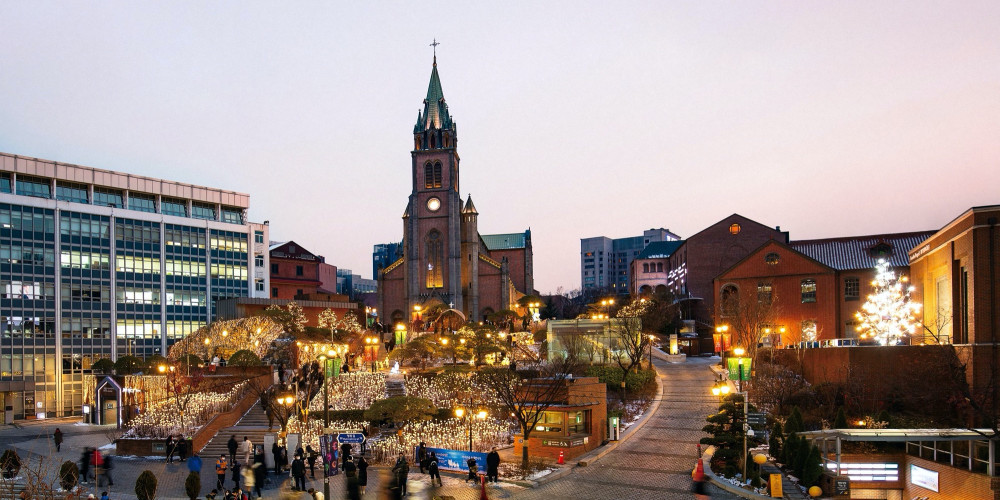
A rising, vertical rhythm momentarily interrupts the rapid pace of downtown Seoul. With its soaring Gothic arches and spires, Myeongdong Cathedral is the undisputed symbol of the neighborhood. As both a monumental structure in the heart of the modern city and the very first Roman Catholic parish in Korea, it is far more than a religious site; the landmark is a repository of the city’s collective memory, a quiet anchor for Myeong-dong’s rich history and significance.
A few alleys away is the Myeongdong Theater, built during the colonial period. The building once served as the national theater and was the beating heart of Myeong- dong’s cultural scene in the 1960s and ‘70s. The National Theater of Korea relocated in 1973, and in the early 2000s, the building faced the threat of demolition. But local merchants and artists campaigned for its restoration, and the government eventually stepped in, purchasing the site and saving the historic building. After a meticulous three-year restoration, Myeongdong Theater was reborn, and its beautiful original facade was left untouched.
The theater’s architecture might loosely be referred to as “Japanese-influenced Western-style,” which incorporates a unique blend of Neoclassical-style columns, stone masonry, Art Deco-inspired tiles and medieval motifs. This hybrid style can also be found in other nearby landmarks, like the Renaissance-inspired stone facade of the Korean Electric Power Corporation Seoul headquarters and the French Baroque features of the Woori Bank Jongno Branch. These buildings are vestiges of a time when electricity and telegraphy were the hallmarks of a modern nation. Imperial Japan adopted and adapted these Western architectural styles as a way to assert its own modernity. But what’s truly important is that while the buildings of Myeong-dong may be painful relics of the past, they also preserve heritage, embracing a new, modern purpose by gracefully weaving their histories into the cultural fabric of the present.


© SHINSEGAE
Streets Depicting Tastes and Trends
In 1930, a brand-new type of building appeared in the heart of Seoul for the first time: the department store. This was a space that revealed the identity as well as the tastes and trends of Gyeongseong (the name for Seoul during the colonial period), and nearly a century later, that spirit is still very much alive. The main branch of Shinsegae Department Store, which stands on the site of Korea’s very first department store, recently underwent a massive renovation. The existing main and new buildings were reimagined, and the historic former Cheil Bank headquarters, a designated cultural property, was given a beautiful new purpose, creating a grand cultural, artistic and retail complex that spans the entire block. This is a place where heritage is preserved and given new life. Here, rather than mere transactions, shopping becomes an experience of immersing oneself in the time and stories of the location itself.
Meanwhile, in the streets of Myeong-dong, you’ll find a vibrant mix of independent fashion and accessory shops offering the very latest in Korean trends. And of course, no trip to Korea would be complete without a deep dive into K-pop. At the specialty K-pop goods stores, you’ll find albums, light sticks and photo cards, all speaking the universal language of global fandom.
Myeong-dong is a living ecosystem where history, fashion and pop culture all merge onto a single path, a place where the trends and sensibilities of Korea, with an increasingly global presence, are constantly being created and then recreated within an organic ecosystem. Here, the memories of the past and the trends of today feed off one another, showing us a city evolving over time.


A Taste of Myeong-dong
Sometimes, when choosing a place to dine in Myeong-dong, the best guide isn’t the menu but the history. In 1935, the poet Yi Sang opened a tearoom called Maek (麥) in Myŏngchi-jeong (today’s Myeong-dong), ushering in an era of modern salons. From there, film and theater actors, painters, musicians and writers set up tearooms across the neighborhood — Seongnim, Eliza, and more — and, through the mid-1960s, Myeong-dong’s cafés around the National Theater (formerly Meiji-za Theater) became a cultural engine where poetry readings, music performances, art and photo shows and theatrical presentations intertwined. This is why a sip or a bite in Myeong-dong today is, in many ways, a taste of the city’s cultural memory from that time. Across from the Chinese Embassy, in a 1950s European-style building that still bears the emblem of the Republic of China (Taiwan), you’ll find The Spot Fabulous, a café that has preserved the building’s unique aura. This beautiful piece of archi- tecture, once a hub of Taiwanese culture in Seoul, is now a stage for enjoying coffee and dessert. And of course, the colorful array of street food stalls you’ll find throughout the neighborhood adds a fun, delicious rhythm to any walk through the city.
For a hearty meal in an iconic establishment, look no further than Myeongdong Kyoja, which has been serving its famous bowls of noodles since 1966. Its menu is simple — not much more than kalguksu (hand-cut noodle soup) and mandu (dumplings) — but with its signature garlic-infused kimchi, it has etched itself into the culinary memory of Seoul. And when night falls, be on the lookout for a hidden door that looks like a traditional mother-of-pearl vanity mirror. It leads to the speakeasy Myeongdong Sookhee, the perfect place to end your day with a beautifully crafted cocktail. The lively energy of the street stalls and the quiet, intimate atmosphere of a modern bar, all coexisting in perfect harmony — this is the very definition of contemporary Myeong-dong.


- Written by Nho Soyoung
- Photography by Jang Eunjoo