
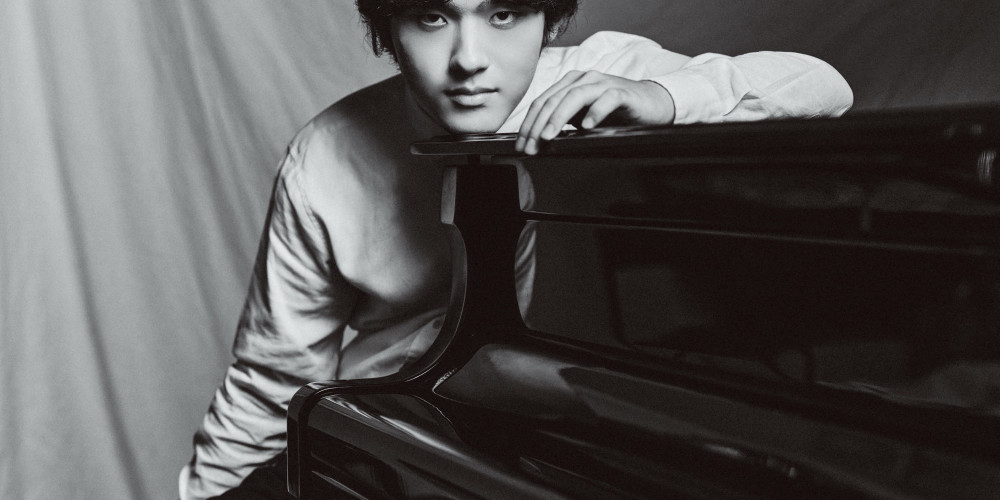
Musical Universe of Pianist Yunchan Lim
When 18-year-old Yunchan Lim became the youngest winner to claim the gold medal at the Van Cliburn International Piano Competition in the United States in 2022, the victory catapulted him to global fame. His way of conversing with centuries-old scores and drawing emotion out of silence is akin to a solitary traveler going for a long walk down the path of music. We embark on a journey to get a peek into the world as Yunchan Lim sees it.
Musical Journey Embracing Freedom and Spirit
Q. There are many kinds of journeys. Some set out toward a destination on a map, while others are a slow walk inside oneself. That latter path is shaped not by outside expectations but by questions posed to oneself, a search for authentic emotions and a personal means of expressing them. I wonder if your music might be such a journey.
Yunchan Lim⎮ I believe that listening to each note and judging it by ear while performing music is simply a matter of technique. For me, the goal is not just reproducing the notes, but breathing my entire soul into them to create music. That requires a poetic imagination to sketch something beyond the score, as well as a passion that burns like molten lava. That’s why, whether in rehearsal or on stage, I always begin by focusing on the very first note. If that sound and the story behind it don’t strike me to the core, I can’t move on to the next one. Only sounds that touch my heart give me the freedom to truly hear myself. In the end, I believe that an artist is someone who goes beyond technique and passion to sing of freedom alone.
Q. Since your victory at the 2022 Van Cliburn competition, your presence on the international stage has expanded significantly. What do these encounters with unfamiliar cities and audiences mean to you?
Yunchan Lim⎮ For me, travel is synonymous with freedom. I always find joy in engaging with new things. The act of discovery — whether of a city or an audience — feels like one of the only true pleasures available on this tiny planet. I guess that’s why I want to keep visiting more cities and countries and have a life of abundant experiences. I feel immensely grateful that my profession allows me to travel so widely and, in doing so, gain essential insights about life. But now that I’m on a bigger stage, so to speak, I regularly feel the need to shape and express my own story with greater clarity. I put a lot of thought into framing an inner vision that feels uniquely my own.

Q. Many critics feel a sense of poetic reverie in your performances. Besides music, is there anything else that helps you broaden your horizons?
Yunchan Lim⎮ I often draw inspiration from other art forms, and they can definitely help. But for me, the greatest source of inspiration comes from my childhood memories and experiences. From an early age, I’ve been encountering the world through the piano. When I was seven, when other kids were going to taekwondo classes, I saw a piano studio in a shopping center and just decided to start playing. I wasn’t learning on a technical level at first — I was just grappling with the piano on its own terms in those classes. I think those early memories and feelings may represent my realization of how to fully accept and understand things with the heart, rather than simply knowing them with the mind. Even now, I’m more focused on feeling than judgment.
Q. I heard that you consider moments of silence with the audience important during performances. What do those moments mean to you? How would you describe an ideal relationship with the audience?
Yunchan Lim⎮ Honestly, I’m a bit nostalgic for the old days, centuries back, when the boundary between performer and audience wasn’t as rigid as it is today. When music is being played, there’s a natural distinction between the performer and the listener. But I see both roles — both the person performing on stage and the people listening in the audience — as being part of a community enjoying the music together in that moment. These days, people tend to view musicians as professionals, so they’ve come to expect more from those performing on stage. But despite being part of performing culture today, I still sometimes find myself longing for that older era. That’s why I want to bring more of what I consider the essence of music onto the stage. I expect my music will surge like waves of lava, searing the hearts of those who listen, and my own soul will be right there with them.
Growth and Recreation
Q. How do you see yourself continually growing and changing as a musician?
Yunchan Lim⎮ For an artist, growth means breaking down who you were yesterday — your old self — and creating a new self. The French poet Arthur Rimbaud once said that an artist makes himself a seer through the “derangement of all the senses.” For Rimbaud, artistic inspiration comes only through the pain of complete self-deconstruction. I think an artist needs to experience this kind of “derangement of the senses.” While breaking down the old self involves pain, that process of deliberate deconstruction brings you closer to your new self. Accepting both that pain and that joy is what turns the artist of yesterday into someone new.
Q. For someone like yourself, who has spent so much time with the piano since childhood, what do consistency and immersion mean to you? Why do you think those qualities are important not only in art, but in other aspects of life?
Yunchan Lim⎮ I’ve always thought a spirit of unwavering devotion is the essence of being an artist. It’s like the old saying: Even if the world were to end tomorrow, I would still plant an apple tree. I think that sustaining hope and staying true to one’s beliefs without wavering, even when the world is full of deceit and wickedness, ought to be close to the artist’s heart, as well as the core of their artistic life. I think that’s how we grow.

Transcending Koreanness
Q. How does your Korean heritage influence your performance on the world stage?
Yunchan Lim⎮ I see Koreans as being a people whose souls are capable of expressing han (a deep-rooted sense of anguish) through song. And I feel like that soulful heritage has a particularly strong and significant impact on the arts. I’m immensely grateful, as a Korean, to have inherited that heritage. But beyond being grateful for what I’ve been given, I also believe that, as an artist, I need to step out of the familiar channels I’ve grown accustomed to and find a way of moving toward an unfamiliar self. Rather than limiting myself to my Korean identity, I want to keep exploring myself as a human being.
Q. Could you tell us about any upcoming performances or projects you have planned?
Yunchan Lim⎮ I’m currently preparing for concerts here in Korea after several performances in North America, including appearances with the New York Philharmonic and the Philadelphia Orchestra and a recital at Boston’s Symphony Hall. On December 4, I’ll be performing at the Concert Hall of the Seoul Arts Center with the Orchestra dell’Accademia Nazionale di Santa Cecilia under the baton of Daniel Harding, so I’m really looking forward to seeking Korean audiences again. After that, I’ll be touring various Asian countries. In January next year, I’m scheduled to perform with the Royal Concertgebouw Orchestra in Amsterdam and Dortmund. Then in April, I’ll be performing at Carnegie Hall in New York.
Q. One last question. When you consider your present self, what do you imagine your future self will be like?
Yunchan Lim⎮ Until now, I think my whole life has devotion is the essence of being an artist. It’s like the old saying: Even if the world were to end tomorrow, I would still plant an apple tree. I think that sustaining hope and been immersed in music. But from here on, I want to stay grounded, to be more attentive to life and the world around me. I expect my music will surge like waves of lava, searing the hearts of those who listen, and my own soul will be right there with them.
- Photography by Shinjoong Kim / MOC


