
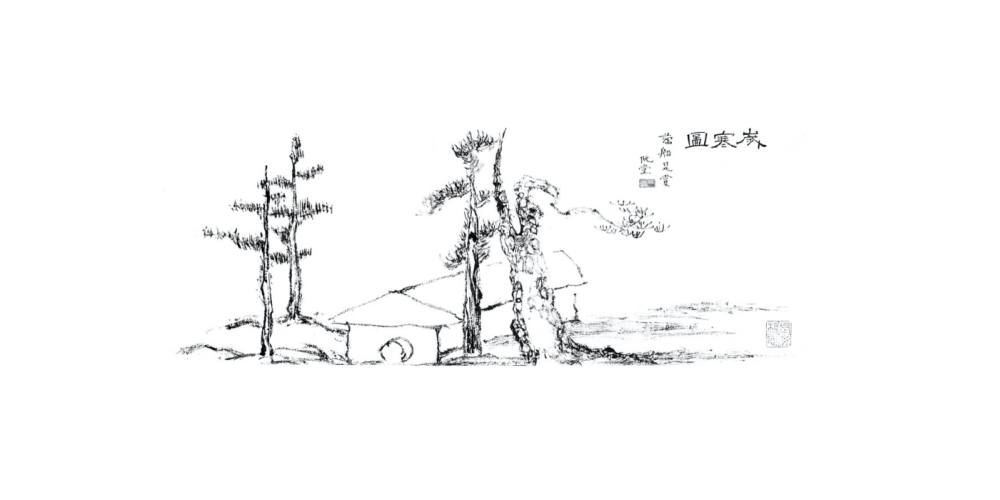
The Art of the Unfilled Space, Yeobaek
For Koreans, yeobaek, or “lingering white space,” is not merely a blank void; it is the heart of an unfinished aesthetic that leaves room for contemplation. It embodies an attitude where humanity, rather than striving to complete everything perfectly, allows the currents of nature and time to help fill the void. This concept dissolves the boundaries between the human and the natural as well as the real and the imagined, drawing the viewer into a state of quiet communion. It is a space created for connection — a sensibility that allows us to feel and embrace more by intentionally leaving a little room.
- Gradation K is a column that explores the beauty and style woven into Korea’s unique aesthetic, from its traditional roots to its modern expressions. Our fifth exploration is of yeobaek, the aesthetic sensibility rooted in the idea that ‘“one fills by emptying.” We take a closer look at this unique appreciation for empty space not as a void, but as a sensory and aesthetic experience that allows us to feel and embrace something deeper.

Image source: Collection of the National Museum of Korea
A WORLD
Beyond the Visible World
A Contemplative Space of Suggestion
The concept of the “lingering white space” or yeobaek exists in a complementary relationship with yeosil — that which is tangibly, vividly real. An empty space is never just a physical void, or gongbaek. The yeobaek, which appears to be empty, is in fact intentionally unfilled, a space to be filled by the viewer. Therefore, within that unfilled space, though an object may not be painted, its presence still lingers in the mind. It has not been erased. From the perspective of energy, or ki, it is also complementary to principle, or li. This is why the empty space of yin, and the painted form as yang, are not considered two separate entities but one singular whole. This is a foundational principle of East Asian monistic thought, a worldview that sees the universe as a single, unified entity. Let us consider the famous work Inwangjesaekdo (Scene of Inwangsan Mountain After Rain) by the great scholar-painter Jeong Seon (1676 – 1759, pen name Gyeomjae), painted in 1751 in his 76th year. Using only ink on paper, he brilliantly captured the impression of Seoul’s Inwangsan Mountain, clearly visible and vibrant after a long summer monsoon, with mist swirling about its peaks. The scene is the very picture of what is known as gwangpung-jewol — an idiom describing the pure, unsullied beauty of nature, like the refreshing wind and the bright moon after a cleansing rain.

The Conceptualization of a Real Landscape
Let’s look at the painting more closely, this time with a specific focus on that lingering white space. The first thing that commands the eye is the artist’s bold brushwork, a powerful dance of dark and light ink. Across the rain-drenched, inky-black rocks of the mountain, a swath of pure white cloud and mist — an area where no brush has touched the paper — flows majestically across the center of the frame. In the dramatic contrast between the tangible ink and the vast, empty space of paper, a new world is born — a world that feels vibrant and brimming with life-giving energy. This is how the simple materials of paper and ink become a direct conduit for the artist’s emotion and spirit. We can also consider the empty space in the painting through the lens of another classical idea called hoesahuso. An idiom which comes from Confucian texts, it suggests that the act of painting comes after, and is built upon, simple, pure white ground. In the painting, the tangible rock is the realm of the “painted.” The lingering white space, the mist, is the original, unadorned ground. Here, the raw material of traditional Korean hanji paper itself embodies human sensibility, achieving that perfect state of oneness. Seen in this light, the painting is no mere landscape. It is a work of philosophy, an abstract representation of a mountain transformed by the artist’s profound understanding of yin and yang.

Created by Kim Jeonghui at around the age of 70 during his late years in Gwacheon. Private Collection
The Beauty of the Eccentric
By this same logic, the art of calligraphy simply could not exist without negative space. The brushstrokes can only truly subsist in a space characterized by emptiness. This is the source of the strange, “eccentric” beauty of chusache calligraphy of the 19th-century master Kim Jeonghui (1786 – 1856), known by his pen name Chusa. We see it in his masterful late works, like the Panjeon Hall wooden signboard found at Bongeunsa Temple in Seoul, and Hagwiyujong (Learning is Rooted in Confucianism), completed when he was in his 70s. The text of this latter work presents a powerful idea: it suggests that all learning — even Buddhism and Taoism — should be encompassed by a broader Confucian understanding. In its powerful script, we see a masterful play of balance and imbalance. Reading right to left, the first character is intentionally top-heavy, its structure strangely distorted. In contrast, the next character, made of just a few simple strokes, is rendered boldly, lending a sense of equilibrium to the whole. The last two characters are completely reimagined, their structures radically different from any standard form, rebuilt according to Chusa’s own unique vision. In so boldly breaking the rules, Chusa was doing more than just playing with letters; he was giving new visual expression to the very meaning of the words.
This is the state of bulgye-gongjol — a mind that has moved beyond any calculation of “skillful” or “unskillful.” It is the pinnacle of this eccentric aesthetic, a return to an almost child-like script. In this, we see the ultimate beauty of what it means to be free from worldly concerns — a beauty that is at once playful, innocent and even a little foolish. This is why in the East, calligraphy is often called simhwa (心畵) or a painting of the heart.
The Meaning of Bending and Stretching
Now, let us return to the Hagwiyujong (Learning is Rooted in Confucianism), this time from the perspective of the empty space. When we shift our gaze from the characters themselves to the spaces between the strokes — to what Chusa called the “meaning of bending and stretching” — the work begins to read not as text but as a painting. If the strokes are the tangible part, then the energy in the empty spaces between them is the vital, unseen spirit.
Here, around a century before Western abstract expressionists such as Robert Motherwell, Chusa was already articulating the very essence of their art — the gesture, the rhythm of the brushstroke — and in doing so, declaring that his work was not mere writing but painting. And it is in the lingering white space that his calligraphy truly soars, becoming a timeless expression of pure, playful absorption. It is a return to the primal aesthetic innocence of a newborn child, the very origin of all art. In the end, what these two masterpieces, Inwangjesaekdo (Scene of Inwangsan Mountain After Rain) and the Hagwiyujong (Learning is Rooted in Confucianism), both make visible is the unchanging Eastern philosophy that the world turns on the unity of yin and yang. Today, we live in a historic moment where the tangible, data-driven world of artificial intelligence has, in many ways, surpassed human ability. And perhaps for this very reason, we have never been more profoundly in need of the wisdom of the empty space.
- Written by Lee Dong Kook
- Lee Dongkook is the current director of the Gyeonggi Provincial Museum. He worked for 35 years as a curator at the Seoul Arts Center’s Calligraphy Art Museum. He has served as a review committee member for the National Museum of Modern and Contemporary Art, Korea and the Korea Heritage Service, and a member of the Gyeonggi Provincial Museum’s artifact appraisal committee.
THE MOON JAR: Korea’s Beauty, Shaped by Empty Space

Estimated to have been produced in the late 17<sup>th</sup> century, it measures 41cm in height, 20cm in diameter (mouth), 16cm in diameter (base), and 40cm in diameter (body). Displayed in the museum’s Buncheong Ware and White Porcelain Gallery, the piece offers a renewed sensory experience through its fusion with media art.
Photo by Jo Jiyoung

© Whanki Foundation / Whanki Museum

© Koo Bohnchang
Among all of Korea’s traditional ceramics, there is one particular creation that has a unique way of capturing the heart. It is a large, round vessel of pure white, reminiscent of a full moon’s soft and tranquil glow. It is, of course, the moon jar. Its curves are not perfectly symmetrical, and in this, it possesses a gentle, approachable warmth. Anyone who has visited one of Korea’s leading art institutions, such as the National Museum of Korea, Leeum or the Horim, has likely had the experience of pausing before one of these magnificent pieces. In their quiet presence, they seem to embody the very essence of the Korean aesthetic. Known as baekja daeho, the moon jar is a type of large white porcelain artifact that was produced in the official court kilns during the late Joseon Dynasty (1392 – 1910), in the 17th and 18th centuries. The moniker “moon jar” itself was said to have been coined in the 1930s by Go Yuseop (1905 – 1944, pen name Woohyun), considered to be one of Korea’s earliest art historians. Asakawa Takumi (1891 – 1931), one of Japan’s leading art philosophers, was captivated by this porcelain and went on to study Joseon art. Japanese art critic and philosopher Yanagi Muneyoshi (1889 – 1961) likewise described the moon jar as a vessel embodying mu (nothingness) and gong (emptiness), the very essence of Eastern thought. Another great admirer was Bernard Leach (1887 – 1979), the famed British potter known as the father of British studio pottery. He once said that owning a moon jar was like owning a piece of happiness. As such, the moon jar was already an object of international fascination.
So why is it that this humble, unadorned vessel inspires such devotion? The artisans who created these jars would first throw two large hemispherical bowls on the wheel, then join them together. As a result, the final form was never a perfect sphere, but always possessed a subtle, charming asymmetry. And it is in this very imperfection that we find a natural, living quality. A full moon, after all, is not a perfect circle. This embrace of natural beauty is the core of the moon jar’s aesthetic.
In its heyday, the moon jar was popular among both the common people and the aristocracy in Korea. While they were used in royal ancestral rites and court banquets, they were also a familiar presence in the daily lives of the noble scholar class. Yet, the artisans who created them were almost always anonymous potters who left no trace behind. There is a deep, resonant beauty in this — a profound sense of awe that comes from realizing that such incredible artistry sprang from the simple aesthetic sense of these unknown, unpretentious artisans. It’s a powerful reminder that true beauty comes from a pure heart, and that it is unadorned sincerity that truly moves us.
The moon jar’s curves are not uniform, but it is this
very imbalance that gives it such a profound emotional resonance, beautifully showcasing the harmony of asymmetry that is so central to Korean aesthetics. Its pure white surface, devoid of any decoration, evokes the beauty of empty space, another key aspect of East Asian art. This unadorned space becomes a canvas, an infinite vessel that can hold the heart of the viewer. There is an ancient, and admittedly difficult to grasp, teaching in Eastern thought, which states that “being and non-being give rise to each other.” Looking at a moon jar, one feels this is exactly what it means. And if you look closely, the tiny, subtle traces left on the surface — a testament to the meeting of earth, fire and the artisan’s own breath — are a wondrous combination of serendipity and inevitability.

© Ik-Joong Kang
Last year, a moon jar was featured at the global trade show Cosmetic 360 in a special exhibition called Korea’s Scent. Held at the Louvre Museum in Paris, the moon jar, along with the works of several other Korean artists, captivated a global audience. The Metropolitan Museum of Art in New York also has a moon jar in its Korean collection. Such examples are a testament to the fact that the moon jar is no longer just a cherished Korean legacy but a symbol of universal beauty. It is not a relic of the past but a living, breathing part of Korea’s cultural heritage. The great masters of modern Korean painting — Kim Whanki (1913 – 1974), Park Seo-bo (1931 – 2023) and Lee Ufan (b. 1936) — all found inspiration in the moon jar’s simple beauty, expanding their own artistic worlds in response to it. And today, a new generation of master contemporary ceramic artists, such as Kwon Daesup (b. 1952), Lee Yongsoon (b. 1957), and Choi Jiman (b. 1970), are creating their own modern moon jars, keeping the spirit of those ancient artisans alive in the here and now.
- Written by Lee Jinmyung
- Lee Jinmyung is a curator and researcher specializing in art criticism, aesthetics and Eastern philosophy. He served as a curator at the Kansong Art and Culture Foundation, and the chief curator for the Daegu Art Museum. He is currently a visiting professor at Sungkyunkwan University.
- Edited by Choi Jini
- Images courtesy of the National Museum of Korea


